Translate

Sunday, September 7, 2014

Camino Eight – The Hospital of the Soul


06.06 a.m. I leave North London and walk 20 kms to Hornillos del Camino with my full pack.  I am suitably amazed with myself!  A man led me out of Burgos, passo del Rio, to turn right where the cockleshells were clear.  I walk alone for a couple of hours, no rain, wondrously cool and Yves stops to tell me all about his wondrous randonée chariot made in Lille .  I reach Tardajos, meeting up with Vanessa and John along the way.  As we eat breakfast and the Lovelies share their woeful tales, the other Frenchman walks by with his donkey.  The French!  They are so inventive. 
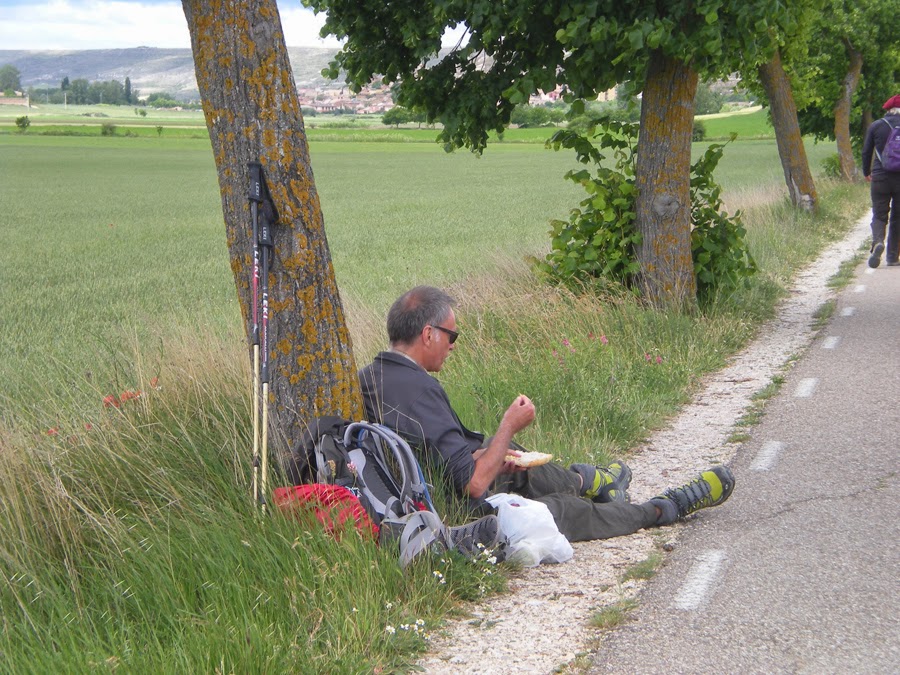
Vanessa has pulled a tendon and we walk slowly together, further on the three of us picnic on the poncho.  It is a pretty walk, wheatfields and poppies, corn cockles and cornflowers line the path. We reach Hornillos del Camino and neither of us can walk another step.  Vanessa takes a couple of my heavy duty Ibuprofen and when the pain in her leg has gone she heroically sets off to find a private Casa Rural as the only albergue was full.  The Casa is a splendid new house built by two generations, the third generation was three months old and winning over all who coo-ed at his gurgling smile.   Our room was large, heated, three new beds covered with thick duvets and luxurious satin counterpanes, ensuite and we had the use of an extremely well-stocked kitchen and fridge.  The young couple’s generosity was touching – we were almost the first guests of their brave venture and while we all know pilgrims are a ready income many walkers can be selfish, demanding and disrespectful.  I would love to think the kindness of this family is never abused, their golden generosity never tarnished.


Vanessa was fairly bouncing after the Ibuprofen and cooked a superb pasta filled with all manner of good things.  She invited a stray Norwegian to join us; the woman had a stentorian voice and found herself highly amusing.  She didn’t pause for breath after speaking but rocked herself into an insane laughter before taking up the previous thread and continuing her confused anecdotes at a volume of decibels just short of an invitation to murder.  She was oblivious to any hint that John, Vanessa or I just may have had wanted to say a word or two ....  I ate and fairly scooted upstairs to the silence of our room.  

Today is the second day of walking the Meseta and we are off to Castrojeriz, 20 kms ahead of us.  It is pure magic to walk.  10 degrees C, slight breeze, lowering clouds, chiaroscuro of dancing light and shade as the wind jostles clouds across the sun.  We all leave at the same time but soon separate as we find our own pace.  I pass a man on crutches, hospital crutches, but he has a mochila so he intends walking the Camino.  A rainbow arcs across the sky right over him.  


Ahead a plump young woman wearing star spangled black leggings smiles happily as I pass her and tell her how lovely they are!  Poppies pose in perfection; birdsong, similar to a pardalote follows me.  I stand for a long time trying to see the source of this surprising sound as I know it is definitely not a pardalote, but even as it accompanies me I am unable to catch sight of it in the thick waving wheat.  A frisson of nostalgia ripples like the wind in the wheat across my storehouse of memories:  I would spend hours watching these tiny birds burrow nests in the coastal sand dunes at the foot of my garden near the Kingscliff coast forty years ago. 

We all three walk into Hontanas as the church clock strikes ten, spend a moment or two photographing the shrine of St Bridget.  I completely forgot, if I ever knew, that she and her husband went on pilgrimage to Santiago de Compostela in the 14th century.  When they returned to Sweden her husband died and she became known for her works of charity, particularly toward unwed mothers and their children.   Birgitta became a member of the Third Order of Saint Francis and devoted herself to prayer and care for the poor and the sick.  I stayed with the Brigidine Sisters of her religious foundation last Christmas when I went to Assisi.


In the main square of this hamlet a surprise – Ela and Christina, last seen with Paulo Coelho!  I introduced all these Lovelies to each other and they both warned us to bypass the first café, the coffee was lukewarm.  They had spent a miserable night in the albergue that was full, back in Hornillos. 

The second and third bars were closed but from the last came a divine smell of food.  We forgot the coffee and had hot fresh chicken soup for the soul and bought pan du chocolate straight from the oven to take with us for picnics.  As we sat there John, ruing the loss of his camera, said that in the Middle Ages there had been a Papal Bull stating that pilgrims who steal from pilgrims will burn in hell.  A most restorative thought.  The Jacotrans driver came in with mochilas for the albergue, saw my walking stick and recognised its menomic of red and white polka dots, smiled and said: “your mochila is safe with me”, and drove away to deliver mine to Castrojeriz.

We paused to explore the atmospheric ruined Abbey of San Anton, niches of little Santiago statues and remnants of Tau crosses gave a special sense of being surrounded by Presences, and not quite as alone as we thought we were.  The great doorway held significance for early pilgrims and alms of food would be given them as they passed on to ... Castrojeriz with its single street of three kilometres. 


That’s half way to the next village!  We take a room for three at the Albergue de Peregrinos, a splendidly restored barn and mill that also offers a pilgrim meal.  We shower, refresh and go to explore.  John and I walk to the end of the village, and prove what happens when one walks and talks in two’s or three’s or more – we miss the essentials. 

On the return walk – can I imagine adding all these extra kilometres to a walk of what will be for me, with detours, 800 kms, I must be daft – we meet Vanessa who excitedly tells us of an enchanting encounter at the Hospital of the Soul.  We had walked right passed it.


Hospital del Alma, a house with no doors.  How could I have missed it?  It was a miracle.  Mau and Nia met some years ago on the Camino and eventually they settled here and opened their extraordinary home, a renovation in process, their creative selves and their love for the Camino to all who were led to enter the open front door.  There was a front door, only.  Mau said there had been so many doors close in his life he wanted to live only with open spaces under the lintels.  We were invited to wander at leisure, help ourselves to the cakes and teas and fruit spread on the rough hewn table.  Their home was filled with curiosities, cottage antiques, salvaged charms of painted and decorated panels, fabrics, textures, flowers, herbs, fragrance: rose petals in bowls of water, incense, holy silence, a photographic exhibition.  Paths, paved, cobbled, sgraffito’d, led around the garden to the caves at the back where Mau and Nia had built the Wild Chapel, placed the Laughing Cross.

The Camino, said Nia, whose beauty held me spellbound, is not done with our feet, but our Life.  They spoke of chasing shadows, those ephemeral will o’ the wisps named success, fame, fortune ... well, success, fame and fortune have all escaped me. 

Being in the presence of Nia and Mau I felt a sense of being enriched in my  0wn presence. 
I used to feel that in the presence of my friend Bahli when she was alive; she too would give meaning to the tessarae of my own fragmented existence which gives me grave cause for concern at times.  I look back over emptiness and a few colourful dots.  Bahli said those few colourful dots were what gave her faith in her own journey.


After such blessings I spent a sleepless night – it was about now that I learned microsoft had blocked access to my email so thoroughly I was unlikely to ever contact my world of friends ever again. John had tried every which way unsuccessfully to access it through his laptop.  I fretted and counteracted my thoughts, fretted and counteracted with positive alternatives the whole night through. I was so cross with microsoft, how can they do this, I argued to myself, to a nearly 70 year woman walking alone 500 miles across northern Spain, in a country whose language she doesn’t know?


 Would the nerd who blocked it do this to his mother, his grandmother? I fumed.  I knew I had to really stress now so I could let the whole scenario go tomorrow – which is another day.  It worked; I finally rose, dressed and pronounced – well, that’s it then, I’m free to walk without bothering about blogs, friends, or anything else.  For a nano-second I wondered if my long silence might prematurely invite the Requiem Mass I’d left with Father James, but sent the thought packing.  So what if it did ... Resurrection’s not new ...


To be continued ...

Z xx


Camino Seven – Burgos, Brollies and Polka Dots

Burgos was so cold and the rain so heavy it penetrated my poncho.  When Simone had removed her poncho to hug me she was also dripping wet underneath it – two dripping dames.  Our ponchos were well respected brands intended for poor weather, but not Camino weather apparently.  I trudged on along the street at a trajectory from the vast Cathedral, only dimly aware of the attractive shops to the left and right of me.  Where was I to go?  I didn’t know.  I was numb with tiredness and cold.  Reaching the end of the pedestrian way I saw with a sense of gratitude the scallop shells set into the centre of the cobbled road.  I had met up with the Camino again.  I looked around me.  On my right was a rather grand hotel façade with a proud few stars under its name: Norte y Londres. 


My goodness – I was born in north London way back in Dreamtime – this must be a Sign!

I sighed, to give myself a sense of courage, and took my dripping pilgrim-worn self into the chandeliered and sparkling foyer.  The receptionist didn’t bat an eye as I found myself asking if they had a room, for two nights.  They did.  Top floor, double room, single peregrina price of 40€ per night.  I’d done it, cracked the Calvinist!  And there was a bath, and thick white towels to dry with.  I peeled off my sopping clothes, strung up my trusty washing line across the windows and hung everything.  By looping the cord over the hinges of the open windows the rain didn’t come in as the windows, being on the top floor, were well under the eaves. The poncho I hung over the shower rail once I’d had a long, hot, sublime soak in the bath.  I was a new woman after that and dressed in my other skirt, other top, dry socks and sandals.  Socks and sandals!  I cringe that I could ever have walked the streets of this elegant city wearing socks and sandals! But my boots were wet and my hotel room was warm – it was important that everything I had would dry properly.  And off I went.

Monsoonal rain drove me to enter a bespoke umbrella shop; I went inside and coveted two.  I had to tell myself that back in Glastonbury I have a collection of umbrellas that stop traffic; once, a woman tapped me on my shoulder as I walked passed the Clock Tower in Tref-y-Clawdd one wet day and said that particular umbrella was worth mugging for! 

I have Valentinos’ and Florentino’s; a Pierre Cardin with pearl raindrops sewn all over; a Ruby and Ed with frills; a My Fair Lady Ascot stripe in black and white; an umbrella decorated with a wet Parisian street scene bought from a street vendor on a similarly wet day in Paris and a Parisian vintage with a double layer and ebony handle circa 1951 and given to me by Greek friend who lived in Paris then.  I have micro brollies in handbags and micro brollies in the car, an Alfa Romeo brolly that almost covers a pond – I do brollies really well.  I did not need another brolly, no matter how monsoonal the weather today, or tomorrow for that matter, I would curl up in my warm room and have three hot baths instead.


First, food. From an organic delicatessen along from the bespoke umbrella shop I bought slices of Serrano hams, artisan bread, water, Tarta de Queso.  Round a corner I came upon an entire shop of organic yoghurts from every region of Spain and from every source of milk – ewe, cow, nanny goat.  I was dazzled by the selection with their stamps and seals of authenticity but dazzled didn’t deter me from buying one too many.  Then to a greengrocer for sweet white-fleshed remarkably juicy peaches, luscious ripe tomatoes and, hurrah, a Lebanese cucumber.  This is the one vegetable I still miss from life in Australia - their flavour, their non-acidity, their fine skin and their small size makes them perfect for halving length-wise, sprinkling with a touch of pure sea salt (Guérande or Gozo), letting the salt rest on the flesh for a while and then eating them just as they are.  Delish.
Now I need a hot three course pilgrim meal to set me up for hibernating for a couple of days with picnics until the rain stops  I find a tiny family restaurant off the main pedestrian way and am served by the portly owner with food cooked by his mother.  Seeing my pilgrim status the owner plumps a photo album of his own Caminos’ down on my table to look at.  He had walked all four, criss-crossing Spain a mere four years ago.   Manolo’s considerable portliness was a huge encouragement for I must be the only peregrina to be putting on weight from all the amazing food.
Full fed and calm again, laden with all my delicious purchases, I walk back to Naughty London, mostly protected by shop awnings and the canopy of other umbrellas.  Life size street sculpture in this rather grand city is impressive; I love the young woman walking out under her umbrella.  Rain must be a given here.  A peregrina from Cairns told me she had carried a pink umbrella when she walked her Camino.  How gorgeous!   I pass an accessory shop and pop in to look for eyeliner, none there, but to my surprise and delight I find a red and white polka dot Alice band. 
 I laugh at the image of me wearing it as I walk into Santiago – and buy it, just in case.  There it is, with its mirror mnemonic on my rucksack which causes much mirth, especially on my boots which are often photographed by other pilgrims.  When I’ve taken its photo I notice that my bed cover is also red with tiny white dots.

Laughter re-activates my endorfuns which in turn brings me the best night: holy sleep, holy solitude!  A cosy bed with white soft cotton sheets, under a thick camel coloured merino wool blanket, a warm room and the bliss of ... holy silence.
It is still raining hard the next morning but I am staying two nights, and for sure the weather will clear on the third day.  Things happen in threes.  I read the room brochures – the hotel was founded in 1904, is “dean of the City” and the oldest of all the Posadas del Camino de Santiago.  Well, well, what a blessing I have been led too, and I send up a prayer that Simone slept well too. 


There were a couple of times through  my second day when the torrential downpours lessened enough to give me a sort of dry run to the Cathedral, a staggering building with splendid artwork.  But having reached it, and wandered about its shop and entrance, I simply can’t bring myself to go in.  I want to explore the old city walls and great ascending steps built by Alfonso X, Alfonso el Sabio, who commissioned Catholics, Muslims and Jews to his Court to compose music, hymns and cantigas to the Virgin Mary. 

 Spain during the 13th century, when King Alfonso reigned, was, like him, wise.  It was also home to Islam and Mary in Islam holds as much weight as in Catholicism.  I learned this during my long pilgrimage along the Old Silk Road during the 1980’s when I became enamoured of a Kurd, the Kurds and Kurdistan, a combination which greatly broadened my education in theology, geography, politics and ... kilims.  My Camino pilgrimage, though I can’t articulate even to myself why I am doing it, inclines me to reflect on those deeper verities that were once embedded in the soil and soul of Spain. 

The views of the Cathedral from high above the city were splendid, worth my long climb.  The rain caught me out once I left the shelter of the forest but I had the hot bath to look forward to for comfort and didn’t much mind.

I loved the old centre of Burgos in the environs of its Cathedral, its Museums and Art Galleries, small churches, street sculptures, river walks, elegant people and special shops and spent every hour exploring and visiting what was there.  A nun leaving the St Vincent de Paul hostel blew me a kiss as she trotted off down long flights of steps to the lower part of the city. 

 Tomorrow my footprints here will be blown away with the wind; though never seen they will remain like ghostly footsteps of all the peregrinos who have set their step to Santiago for over a thousand years.  The thought is wholly nourishing.  I love my feet.
And on the third day when I look out of the window there is enough blue sky to make a pair of sailor’s trousers – the rain is passing.

It is difficult to leave such comfort but exciting to be on the Way again for now will begin days of walking the Meseta all the way to León and the very thought is thrilling. 
The Meseta evokes strong reactions – some hate it, some think it too boring to walk so take buses to avoid it, others are passionate about the contemplative impact of six, seven or eight days walking across the endless high tablelands of wheat with little to distract their thoughts.  An Australian songwriter friend said of his crossing the Meseta that he was taking his life for a walk, and he used the time as an interior résumé.
I had never walked much in Australia, its open bush didn’t invite intimate exploration for a lone woman and refugios hadn’t taken route along the droving trails.  However, the vast skies and open horizons there always send my pulse racing.  An ancient remembrance of the nomad buried deep in my soul burned inside me, a response to walking as a way of life.  Hermit? Monk? Sannyasa? Peregrina?  Who would know.  
I fill up my water bottle, tie my food in a plastic bag and loop it over the waist straps of my mochila, NOK’d and 1000mile sock’d my feet, roll up my poncho and walk out into the crepuscular light. 

Tardajos is a small village ten kms further on, the world of pilgrims gather there for coffee and el desayuno.  The Australian Lovelies had caught up with me with sad tales to tell – they had also stayed a night in the albergue where I had given my bunk to Simone.  They had a top and a bottom bunk.  In the morning Vanessa picked up her mochila and was on her way to the landing and stairs as John was climbing down from the top bunk.  He had already swung his daypack down to the lower bunk as V. was leaving.  When he reached the floor and turned to collect the daypack, in that split second, it had gone.  Taken off guard he thought Vanessa had taken it as she had left, so, hurriedly putting on his own mochila, he caught up with her on the stairs.  Alas, she hadn’t picked it up. Worse was the loss of his camera, a top of the range Sony DSLR, in the bottom of his daypack.  With it went its memory card and hundreds of photos.  Their stay there was made worse, he said, by the arrival of a group of older NZ women who had bussed it all the way from somewhere and were standing in the registration queue almost adjacent to the bunks - one of their kind was refusing to pay the hospitalero the paltry donativo of 5€.  Poor Spain.
A familiar smile greeted us as we ate breakfast – Amalia from way back in Agés.  Her story added to the grim tales from Burgos.  She was having lunch in a bar on her first day, her mochila safely stowed under her table, but when she had finished her meal and had bent to retrieve it, it had vanished.  The entire mochila had been spirited away from under her very nose.  She had to replace absolutely everything.  It cost her dear in days, the city is large, what she needed was out in the satellite shopping centres.  Lucky she spoke Spanish.
Across the road we watch a French peregrino and his donkey pass by.  Man and donkey walk side by side, had come from somewhere beyond the Pyrénées.  The Way calls, we lift our mochilas and take to the road.

To be continued ...


Saturday, August 30, 2014

Camino Six: Storks, Roses and Rosemary

  San Juan de Ortega 
During the evening meal, under the watchful gaze of Paulo Coelho, mine host, Acacio, tells me I should write a book on aging and women and walking the Camino.  He seems to think the research I did in preparation is impressive.  Celso, the Brazilian, looks at my mochila and pronounces it ‘military’ ... too heavy by half.  Jüergen has shin splints and walks slowly, limiting himself to 15 kms or so for now.

     In the morning warm goodbyes are said and we head off into the wind.  The rule at this albergue states no one is to rise before 7 am.  Very civilized.  My day’s walk is a joy.  I pass through Grañón, pause at the bakery of Jesus where hot bollitos are just being drawn from the oven and the fragrance of fresh bread fills the lonely street. 
   
  I talk to everything as I walk, tell everything how perfect it is – puddles, wind, flowers, grasses, birds, lizards, trees – they understand and I am flooded with love.  The Way walks me.  It’s as if I am awakening to a dual consciousness.  Yes, I can still rail at the snorers or whatever else irritates my human frailty, but there is another, deeper, reality which takes over the minute I step onto the true Way and am surrounded by nature.  I’m walking well, the land is singing.  I am overcome by a profound love for my dear feet and plump body, almost apologising to them for embarking on such a reckless adventure at their age.  I love the newness of feeling body-me respond to the superhuman, and seemingly impossible task, of walking 500 miles in my own body! I don’t always live there!
 
 My good humour returns apace and I smile at everything as I enter the marvellous town of Belorado, many kilometres further on, to stand staring in wonder at the extraordinary sight of storks nesting on every ledge of the church bell tower. 


     After admiring the church I continue on to the tiny hamlet of Villambistia where I am greeted by the singularly attractive woman hospitalera of San Roque. San Roque, so well loved in the south of France where he is particularly associated with Mary Magdalene for some reason that escapes me now, is perhaps the archetype of the wounded Fisher King and always accompanied by his dog.  A good place to stop.


 I choose my bunk, but the dorm fills up quickly with gargantuan snorers (no, I don’t snore, said the stupid unaware elderly man from somewhere south of Arlington when I asked him, so as I could be as far away as possible ... duh!).  Above me is Jüergen – we decide we like our company as bunkmates as we agree that each is such a quiet sleeper.  Jüergen is still suffering from his shin splints.  I go for a walk and find a deep cerise damask rose and some sprigs of rosemary.  I bring these back to the dorm where he is resting.  He is awake.  I give him the rose and the rosemary and say he must sleep with these on his pillow and breath in their fragrance visualizing it flow all the way down to his injuries and: it will heal the pain he grins, entering into the play I am inventing as the only way I can offer my sympathy.  He gets it, he really gets it!

The worst night of snoring, according to Jüergen, came from the American who said he didn’t snore.  He snored and rattled and belched and threw himself about the bed – sheer hell for us all.  There is always one.

  Few of us slept.  An Aboriginal woman from Sydney’s inner city muttered darkly but nothing short of pointing the bone would have penetrated that man’s blissful sleep.  None of us happened to have a spare metacarpal handy. It was still dark when we, the sleep ravaged, called it a night and left before murder.  Yet, there’s a crack in everything, that’s how the light gets in, and once again, the moment I was beyond the village and on the Camino, love flooded through me as the birds tuned up for their Dawn chorus, the clouds streaked pink and gold and the sky behind the village streamed light.  No one spoke as we each walked into the morning.

Up to the peaks through the fragrant pine forests I walked, not the dead pine forests we know but pine forests alive with siskins, red squirrels, crossbills and lizards and much more besides.  Over the Rio Cerrata, down into San Juan de Ortega and down down down into Agés.

I rested alone at San Juan, feeling suddenly shy and slightly ill at ease with the bonhomie of so many pilgrims.  Their chatter prevented much interaction with the world around them so when an emerald lizard froze as everyone passed it by I was enthralled when it relaxed and sat while I took some photos before vanishing into the bracken with a quick flick of his tail.


  I walk twenty one kilometres happily, and reach Agés by 2 o’clock.  The first albergue is San Rafael; I so enjoy the company of saints and I stop right there.  A wildly eccentric hospitalero (who refused to be photographed) wagged his finger at me for not booking beforehand but leads me upstairs to a charming room of two by two bunks with pretty blue and white floral duvets, thick pillows, white sheets, a huge built in wardrobe, ensuite shower and loo and views over the fields.  Was it 8€ or 10€?  Whatever, it was worth it!  A woman later came in, asked where I was from. 


 Glastonbury! she exclaimed – I must phone my husband, he is there now, passionate about King Arthur!  Before she phones I hold up my Glastonbury Spring water bottle for her to photograph the label of the Tor which she texts him too!  It is a giggle.  Amalia is an architect from Venezuala.  I go downstairs to eat and when I return to my room on the pillow of the bunk above me there is a cerise rose and two sprigs of rosemary!  Jüergen!  He comes in grinning, I knew it was you he says, I see your hat and your red and white polka dot ribbon!  We are in for a quiet night with just the three of us.  Wonderful.

  Amalia has left at first light, silently, and I silently leave next.  Jüergen is sleeping with the rose on his pillow.  He will walk fast today – miraculously his shin splints have healed; he continues to carry the rose and rosemary attached to the top of his rucksack.  I am rather touched but know that he will now travel far ahead of me.  Encounters like this, short and meaningful, will make up my amalgam of memories.


 Today it rains.  And rains.  I stop for breakfast in Atapueca, a village famous for unearthing stoneaged hominids dating back 400,000 years, the oldest in Western Europe.  (Wikipedia is worth looking at).  Matagrande looms ahead, nearly 1200 metres and another vertical climb.  Only this time it is really difficult, the rain has made the rocky ascent glacially slippery, we pilgrims pick our way footfall by tenuous footfall.  Dry, it may be alright, but wet is hazardous.  We trail like ants, slowly, separately, the sense of deep concentration palpable.  I don’t know how I reach the top, but I do, just as another lone pilgrim is passing the huge cross in the mist.  I stop momentarily, take a photo in the rain, aware of the yellow shrub in this dark and haunting place.


 Thankful I am to leave it.  The descent is not so vertical, ahead of me I see one pilgrim walking slowly - it is Simone.  We greet and part, her poor ill-formed feet are saturated in their sandals.  I am headed for Burgos 20 kms to go and still many hours walk.  The rain is relentless.


 Exhausted, I find the tiny albergue that John Brierley found so appealing.  Big Mistake.  He is such hypocrite – he stays at paradors, paradors I ask you, at no less than 200€ a night – and recommends this pitiful place. 

 It is parochial; perhaps he thinks it ‘spiritual’.  The place is rich with intention but horribly poor with what wet tired pilgrims need.  One shower and one functional loo for sixteen people.  The hot water has gone, the loo is occupied. I am offered a top bunk which I cannot climb up to.  A young male athlete has the last lower one.  I insist on swapping. In my tiredness the noise and proximity of people flips me over to a more than mild insanity and I stand in confusion lost under the armpits of six huge male Californian sophomores on a holiday jaunt to Santiago.

  I vaguely register that these privileged (or they wouldn’t be attending university) young men are here because it is donativo, 5€.  In the same instant I am aware that Simone has also staggered up the three flights of stairs and has been told there is no bed.  Not one, not one of the healthy young things offered their bed to this crippled, wet, 81 year woman.  So far below their armpits stood she that they didn’t even see her. 

 In a nanosecond I reached over and said there is a bed, take mine.  The hospitalero looked at me with such grace, but Simone, removing her dripping poncho, put her arms round me to say in halting English: God has sent you to me, thank you, I can walk no more.  Meanwhile the armpits and elbows above us tried to shuffle about to give an inch of floor space for Simone’s mochila.  I wearily pick up mine and head down the flights of narrow stairs and out into the wet streets, chilled to the bone, soaking wet and lost, to look for somewhere to lay my own head.


To be continued ...