Translate

Sunday, September 7, 2014

Camino Thirteen – A Day of Wonders

I wake immensely refreshed with both a thought and a feeling clamouring for attention.  The feeling was easy to locate, my skin.  During all the days on the Meseta, which runs between Burgos and León, the air was so dry it would cure parchment; it does bear repeating because my poor nose suffered too. I was desiccated inside and out.   All juices dried, my nose felt like a crisp, if I attempted to blow out the crisp my nose would bleed.  Such a nuisance!  Give me woman weather I thought, moist, soft as silk on the skin, humid – winter in tropical Townsville is just about perfection, England has its share of humidity too, in all seasons.  This morning my skin feels perfect again, and I can breathe well.  I look through the window – there has been rain in the night.  
The thought, an intuition really, was insistent: I must phone the Lovelies.  John had given me his mobile number just in case ... I found it and at 7 o’clock went down to reception to ask if I could call. Vanessa answered, her voice a sob of gratitude.  Zoé, she said, I have just ended my prayers to the Green Tara for help and you ring!  You are the answer to my prayer.  We are in Reliegos, it’s horrid, John spent the night vomiting, we’ve been refused a second day, the hospitalero told us to leave, the walk from Bercianos was dreadful and every hotel I phoned in León is full.  I have exhausted all possibilities. 
I ask her to wait two seconds, cover the phone and ask the receptionist if he has a double room.  No, we are fully booked, he says, but there is one suite, just one, for 100€ a night.  I relay this to Vanessa.  Get a taxi I say, just get here, the receptionist will give you 5 minutes to confirm your booking.  She has to ask John. Duh.  Sure enough as soon as I replace the phone it rings, someone wants the suite.  The good receptionist says he will return their call in 5 minutes, replaces the receiver and the phone rings again.  It is Vanessa.  They are on their way.  The receptionist returns the call of the unlucky caller.  León is full to capacity.
 Well pleased with the morning I head off to Q!H for their excellent breakfast – Alfonso’s breakfast, reputedly lavish, is really too costly.  By 8.30 I am at the Cathedral cloisters waiting to go in to the museum.  Weather is wet, windy and chilly.  A priest pushes open the huge door and goes through.  I blithely follow.  He walks along the cloisters and turns left.  So do I.  We come to a side chapel where another priest is offering Mass.  After Mass all leave but I hover unnoticed for half an hour in the quiet of the cloisters. I am cold, I brought so few clothes as June is supposed to be warm, but I rub my arms hopefully and take the time to examine the carvings and the decorative cloister ceiling.  When the door officially opens I appear from the inside to pay the entrance fee.  Led back the way I had been the ticket seller unlocks an ancient door, invites me inside, locks the door behind me and turns on the lights of each of the four floors.  She smiles, and locks me in as she leaves. 

Four floors of beauty and art; one thousand years of priceless treasures of inestimable value all created for the Divine and rescued  from time, terrorism, neglect, plunder – all so lovingly housed here.  My adored Virgins in Majesty, some so worm ridden, so small, so damaged, so hieratic, so calm – their smiles, winks, directness, gaze, sorrow make a seamless silent coloratura of emotion every woman knows. There is no photography permitted, and my camera fails me anyway, unable to focus in such poor light.  I don’t use flash but I do attempt a couple of photos as I am so moved by certain faces.  The anguish of St John as he supports Holy Mary over the pieta of her dead son is so shockingly human, so intense, my own mouth moves in pity; I stand in my own grief for her.  The Angel leading Tobias with his fish, his little dog running alongside is a panel of innocence and poignancy on a staircase wall, and almost missed.  The ethereal lightness of the faces of medieval Angels in carved wood and polychrome; St Lucy, St Catherine, St Anne teaching Mary as a child – all touch me, and all are displayed sensitively. 

 However, the disemboweling of St Erasmus under the leering faces of the watchers and of the holders of the turnspit I found almost too horrific to register until I realize I am also looking at Blessed Richard Whyting, the last Abbot of Glastonbury, also hung, drawn, quartered and disemboweled alive at the age of 80 during the Reformation’ twelve hundred years later.  The Age of Cruelty, parallel to the Age of Beauty, seems a long long time in human centuries.

 A priest comes in from an internal door to let me out just as I reached the last stair down.  Outside in the grand square I am back in ordinary time.
 It is now late morning and I return to Alfonso.  Today I intend buying a lighter mochila.  As I enter the foyer the Lovelies are signing in.  Vanessa fairly flew to me and enveloped me in her arms to thank me.  John’s green and Queen Victoria face – not amused – told me all I needed not to know.  He headed upstairs, disinterested with the demi-miracle of his wife’s prayer and my phone call to extricate him from a situation Vanessa alone could not negotiate.  Gratitude, for John, was not the word of the moment.  I chuckle to myself, take the lift to my floor, get out from the fridge the cakes I’d bought yesterday and ran back down to give them to V.   
Then I’m off again.  First to buy a super light mochila from Roberto down in La Rua street.  He offers me a shocking pink Deuter complete with yellow lily, just for gals, or electric blue.  I cringe and tell him I cannot wear colours louder than the landscape.  He thoroughly approves and goes backstage to find me a cream and fawn Ferrino, Durance 32 Womens, of which I thoroughly approve.  He takes a long time to fit it well, tells me it is a well-respected Italian make of some provenance amongst mountaineers. I giggle, bathos, I think as I imagine me unable to even climb the Tor with a packed lunch.  It was a lovely encounter and I am happy with the result.  


I take it back to my room and scoot back out – to the Fair, via a brief visit to St Francis in the Park; a nodding acknowledgement of serpents to signify apothecaries; a smile for the bubble blower in the street; a life size street bronze of an old man on a park bench - an amalgam of charms that make up this marvellous city of León.


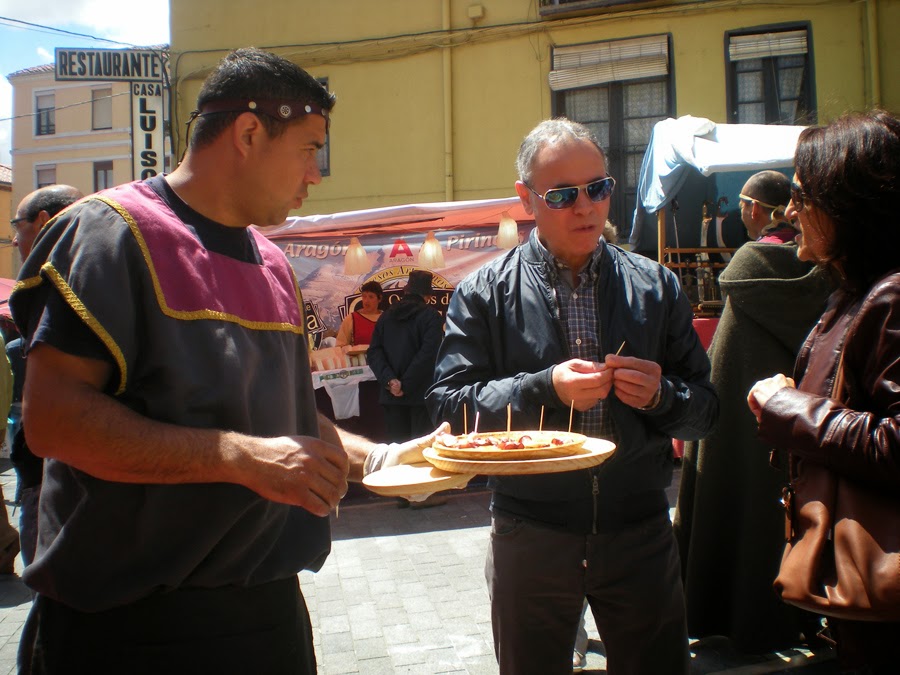
 I arrive just as the Roman Legions march in to disturb the local shepherds and goatherds with their shaggy goatskin bagpipes. This fair is a huge affair, running along all the side streets, filling all the squares with gaiety and colour and irresistible smells. 


I make my way to the Pulpo and Piglet marquee to watch entranced for more than half an hour as a master chef creates a splendid paella.

Each single ingredient is placed by hand, positioned on the bubbling rice and broth base in perfect patterns; giant prawns, langoustines, clams, mussels, tiny shellfish of different kinds, all added according to the timing necessary for cooking, one by one.  I am impressed.  He is impressed with my attention.  Finally it is covered and steamed and I wait.  Chef serves me a wondrous portion for my patience, with every tasty morsel I had been watching transform over the flames of his alchemy.  For you, Senora, he smiles, buen appetito.  I sit at a table and eat blissfully and messily and one of the family comes to wipe my hands with a substantial length of blue paper towel. 
Too late I find a street market that had been given over to antiques and brocante and was packing up, but not quickly enough to hide a treasure.  Oh! Oh! I fall in love with a small roundel of the Virgin and Child in a pastoral scene; exquisite and too well painted to be called kitsch.

I want! I want! my heart cries, and the vendor pounced! Alas, I didn’t have the amount of cash and he didn’t take cards.  I also have a backpack and a further 350 kms to walk – get real Zoé!  The imponderables were insurmountable.  I took a photo, with his permission, instead.  I shall regret not bringing her home with me as much as I regret not 
trying to struggle home with the majolica Madonna water stoop that claimed my heart in Positano some years ago.  Ah well. 
I walk down Avenida San Marcos to the old pilgrim hospital, now the most splendid of all paradors in Spain.  A suite for a week costs my annual income.  I wander everywhere, invisible – I have a knack for withdrawing energy, taught to me by an Inuit shaman from north of Nome whom I met while in Santa Fe way back in 1988.  He sat invisible on the fender of his car, watching me look everywhere for him – he was teaching me traditional ways of communication with the natural world around us, using the elements of which we are also made up – until he suddenly ‘reappeared’. I’ve never managed his degree of invisibility of course, but I can move unseen when I choose to.  

I chose to right now and wandered entranced far beyond the access granted to non-guests.  The twelfth century building is immensely beautiful, its art and statuary magnificent.  I rued the loss of it for pilgrims, but appreciate its protection as an invaluable piece of Spanish history and heritage. A wedding ... a perfect setting; I slipped out as silently as I had entered. 

Along San Marcos Street I had a sublime green apple and chestnut homemade ice cream.  Now I return to their café to indulge, without a nano-second of guilt shadowing my tea and petit four, and bring out my journal to write of the day and my thoughts. I take photos of this extravagantly beautiful shop whose cakes and window display and wall paintings nourish the heart and soul as well as the body and senses and get to wondering.  Ah, the senses.  That’s the conundrum ... sensual.  Too self-indulgent, too sensual, too glorious – too Catholic!  I found shops like this all over France and Italy, and now Spain.  Do we English create such pure indulgent fantasy and feasts for the senses?  


Grandeur, yes.  Gardens, yes.  But pure indulgence? 

What is the common denominator for France and Italy and Spain?  I challenge my brain.  Ping!  It’s obvious – no Puritanism, no guilt, no self-abnegation, no unhealthy boarding school sniggering at sexuality, devoid of sensuality – ha, the list is endless. Cromwell’s Puritans banned mince pies, and Christmas.  Can you imagine anything so punitive!  Charles ll re-instated them.  I so enjoy my little raves, love my journal, it lives with my credencial in my macabi pocket, more valuable than my passport. 


Still the day is not yet over. There is a cello concert by an American pilgrim at San Isidore in the evening.  I miss it; I am waiting at the wrong door.  Photographing a statue of a very raggedy and rusty peregrina in a hat and skirt, who looks like I might look by the time I reach Santiago, I catch sight of a poster for a Son et Lumière to be performed right here this evening at 9 o’clock.  The grand façade of San Isidore will be the ‘canvas’.  By chance I meet Vanessa who insists I follow her back to see a wondrous stone Madonna in her deep vaulted camaril of stars. 


I tell her of the Son et Lumière: what’s that? she asks and I don’t explain, just tell her to fetch John from his death bed – it is not to be missed.  It is stunning!  French illuminator Xavier de Richemont created breath-stopping beauty of the history of León and we were entranced, thrilled, moment by illuminated moment. 
Vanessa thanked me for the beginning and the end of a perfect day for her.  We went home to Alfonso – it has been a Day of Wonders.
To be continued ...


Camino Twelve – León, León, León.


Standing outside the hotel Q!H I look up at the golden stone of the great cathedral, sense the atmosphere of the people passing and instantly fall in love with León.  But first, a little drama.  The hotel is full.  Every hotel is full, there is a mediaeval fare in León this weekend and today is Friday.  Half of Spain is here in this city to enjoy or participate in the re-enactment of the coming of the Roman Legions to León in 29 BC.  I look with dismay at Johnny Depp’s 18 kg mochila, and at Emiliano’s 12 kg mochila, and at my probably 6 kg mochila, and wonder how on earth ...  The receptionist rescues me, leave them all here she says, go and find a hotel. 
I quash my panic, a part of me manages a wry smile as an aphorism I have used on countless occasions pops into my head and dances time with my footsteps: no good deed goes unpunished.  How on earth was I going to shift such weights ... and where on earth was a hotel that had a room?
After a Very Long Time, and endless wandering, I leave the mediaeval part of the city altogether and cross a large piazza to chance upon a hotel and enter the astonishing art deco lobby of Alfonso V. Oh my!  They have one single room left, and let me have it at the peregrina price of 50€ a night.  It is a four star hotel.  I take it, return to Q!H, they ring me a taxi to transport everything and, uh oh, I meet the most foul-tempered taxi driver in Spain!  He does not want to lift what I certainly can’t into the boot of his cab.  I gesture forget it, I’ll get another taxi, and his snarl clearly indicates his greed for a fare.  No good deed goes unpunished – I could easily have carried my own mochila – but the transport of the other two cost me a rip off fortune, and this unpleasant man refuses to carry them into the lobby of Alfonso V!  Abandoning them on the road he drove off quick smart and left me to run up the grand staircase to ask the hotel doorman to help. 

 What, was written across the doorman’s forehead, is this woman doing with such vast mochilas?  And that proved a sticking point.  Mine was welcome of course, and being carried by a Virgo it was still pristine, but these, the receptionist behind the counter curled his lip in distaste, looked at the two mochilas as if they had rolled in from Roland’s eighth century battlefield of Roncesvalles, were not fit to remain in his lobby ...
Imploring the reluctant hotel staff to hold them on the ground floor for the lads I then run back to Q!H to leave cross-references for the whereabouts of their mochila’s as Q!H – our point of contact – wouldn’t keep them in their lobby.  Oh, no good deed goes unpunished ... this unpromising start to my rapturous love affair with León had taken up four hours of my first day.  And I needed food, seriously.
The brasserie attached to the Q!H solved that dilemma.  Now I could enjoy my explorations.  Rounding the corner into the Cathedral Square I bumped into two glamorous gals from Scottsdale wearing macabis’.  Another American peregrina with her husband took photos; these skirts, the ugliest garment ever created, are simply the best invention for walkers, ever
León is utterly gorgeous.  And the Cathedral ... Pulchra Leonina, the House of Light.  Alas my camera failed me here.  The Cathedral is reminiscent of Sainte-Chapelle in Paris and quite simply the most beautiful Gothic stone poem in the world.  It is Light, bringing Light.  Vast stained glass windows, mostly with their original mediaeval glass, divided by stone tracery, sit above those below, an internal division of upper and lower chapels of windows upon windows.  The entire interior is dominated by colour pouring through the two-tiered windows. The vaulted ceiling so high and so sublime I confess I stepped inside – and cried.  It is too beautiful to find words for.  It held me in a kind of rapture.  I went back to the guide to ask for the audio earphones and listened to its long history, its life and hard times, its miracle of survival as the foundations began to crumble some few hundred years ago, it having been built over Roman foundations.  I recognised a Greek name honoured as its saviour stonemason in the fifteenth century, called in by the Benedictines who were the Cathedral custodians.  To miss this wonder is cause for regret – just being there is a sublime experience.  Like all ancient places of prayer and quietude the stones hold memory; déjà vu comes not from the tiny human mind remembering, but the depth charge of stones re-membering us.  In this case – me.  I felt it in Şanliurfa (which was ancient Edessa), in Harran, in Epidaurus, in Men-an-Tol.  I could write of many others but now I am enchanted with León. 
As I wander round the ambulatory I come to another astonishment – a pregnant Mary; Virgin Mary parturient.  I am astonished.  The statue is pretty well life-size, her face has been carved with an expression of such wistfulness as would make any mother weep, as if in expectant knowing of how she would lose her child in a particularly brutal way.  This has nothing to do with religion, but echoes the human anguish we can all feel when someone we know loses a child.
Later, replete, I wander through the setting up of the weekend’s huge fair, marvel at what stalls I can see already, buy samples of cakes, am told to pose for a photograph by the artisan breads of a young woman baker from Galicia, and return to my wondrous room to wash me and my clothes in the marble bathroom.  By now I am feeling rather off-colour again, though the gold embroidered monogram of Alfonso V on the pillowcases and the shower curtain – how decadent is that, a gold embroidered monogram on a shower curtain – bring a smile to my tired face.  This is an unfamiliar luxury in my life and I silently thank Jeff once more.
Fast forward to finish this story – the lads arrived exhausted around 6pm.  They had been walking for 12 hours.  Because he wasn’t burdened with his own mochila Johnny Depp had carried themochila of an elderly, limping pilgrim they met in Reliegos for the last 25 kms.  Emiliano had blisters and looked so woebegone sitting there in the grand lobby as the receptionist went to retrieve their mochilas.  Aren’t you using NOK, I say, surprised.  What’s NOK, he asks.  Johnny Depp whips his from his pocket.  Taken aback I ask the Arrogance of Youth why he hadn’t told his friend, who is Italian and didn’t know, about this French miracle.  With a Gallic shrug (the one that says everyone else is a fool) he answers: he wants to use Vaseline.  As if that was reason enough not to enlighten his friend.  I shake my head, and don’t bother mentioning the taxi fare between hotels.  The trip to León was on me, the extra, which cost nearly as much because of the long route taken to avoid street closures for the mediaeval fair, was really their responsibility.  I sigh, at least the good deed had resulted in another pilgrim having his mochila lifted from his back for his walk.  What goes round comes around ...
It has been a full day.  I sleep more than well under the thick duvet on my excellent bed, covered by cotton sheets of at least 500 thread count.  Bliss.

to be continued ...


Camino Eleven – A Taxi, Templars and Terribly Ill


Hmmm, even in a room of three ...  John snored.  Vanessa, tucked away on the far side, was too tired to notice.  However when she woke she was still in pain and the pair of us decided to levitate beyond Ledigos – in a taxi.  John would walk, he was a ‘bush basher’ from way back, he said, and had sturdy legs to show for it.  

We had the kindest driver who sat without his meter ticking while we stopped to explore the gorgeous Real Monasterio San Zoilo, the old convent once the court of the Kings of Castille and León, on the way.  Sumptuous, cloisters of golden stone Gothic, orchards to wander in, out of the town in a world of its own; we wished we’d stayed as the peregrino price for a three bed suite was affordable.

The Way all along the road was one we were glad to have missed, no secret ways less travelled here, we pass John striding along the footpath that runs beside the bitumen just about all the way to Terradillos de los Templarios.  Another 25 kms day for him.  Lucky for us we arrive early at this tiny hamlet with only two albergues and a many kilometres further to the next one.


We book, dormitory only, into the grand sounding Jacques du Molay, he who was the 23rd Grand Master of the Knights Templar.  He had died a shocking death and I wondered at his connection with this tiny place. 


 We lay on our backs with our legs up against a tree trunk in the tranquil garden, patches of sun between clouds keep the temperature mild, the air so dry it would cure parchment.  I lay here wondering if I’ll bother putting my journal notes into a book, who would be interested in reading yet another Camino chronicle?  My thoughts drift with the clouds above me and a would be title pops into my head: Same Skirt, Different Day by Poppy Peregrina. 

 I love it and turn my head to tell Vanessa but she is sound asleep.
Late in the afternoon John arrives, and countless tired pilgrims are turned away, some look exhausted.  John said it was not a pleasant walk, and he can walk anywhere.  V. and I are so glad we followed our instincts.  I have a not very nice chicken soup for lunch, little except water from the pots of boiling chicken being prepared for the evening meal, with the addition of a barley seed floating in it. I decide not to eat in the evening but V. Has the chicken stew and John has the other dish offered.

Everyone has one Bad Day on the Camino.  I woke to beautiful weather, began to walk through beautiful country, redolent with the intense scent of broom from hedgerows eight feet high planted as a baffle between the Camino path and the main road. 


 I walk more and more slowly, pain and nausea bring me almost to a standstill but I put one foot in front of the other, lean on my walking stick, lurch into an uneven balance while my head disengages from my body which is down there somewhere crying out for attention.

Every step was agony.  The Lovelies were far ahead, the morning rush of pilgrims had passed me by, my hips almost crumbled.

After many miles walking in a kind of delirium I stop.  At that instant Vanessa, a distant speck, must have sensed something seriously amiss.  She turns back.  A goodly wait and she reaches me.  She stays with me, step by slow step, and we make it to the mediaeval bridge and the Hermitage of Our Lady of the Bridge.  John is waiting on the other side.  Once over it I fall down heavily on the grass in front of the ruined Hermitage.  I can no longer move.  Sahagun is another 3 kms or so.  After a while Vanessa props me up, John takes my pack, and somehow I reach the first hotel at this edge of the town; a hotel with a grand foyer and a sympathetic receptionist who takes in the scene in front of him at once.  He calls a taxi.  Vanessa comes with me and just as well for by the time we reach Bercianos del Real Camino we both fall out of the taxi.  She is also ill.


I fall in a heap on the front steps and Vanessa lays flat out on the bench by the old stone wall of this impressive building.  The door opens.  An American says the albergue is closed until 2 o’clock.  I hear it but can’t move.  Vanessa is out of it.  Then I hear a very English voice exclaim in dismay and I look up.  Obviously we are ill.  Spinning through my brain is the blessed coincidence of meeting two English speaking hospitaleros.  Though speaking is not necessary now as David produces mattresses for us to lay in the garden until opening time and Patricia tells me she is from Shalford. 

Synchronicity indeed.  Who would have heard of tiny Shalford unless they knew it personally?  Old and dear friends of mine from Father Bede and Shantivanam days live in Shalford, which is more or less between Godalming and Guildford.  Later we learn that Greece and Australia link us too – but first the pair are off to Sahagun to shop for the evening pilgrim meal and will leave us to sleep in the garden.

Hours later the garden begins to fill with pilgrims, John arrives, and 2 o’clock comes.  I am carried in by John and Patricia upstairs to a small room of two by two bunks.  Vanessa manages to walk upstairs.  We each collapse.  Patricia brings in bowls for us to vomit in, tells us we must stay two nights to recover.  Suddenly V. throws up; three days worth of food three times in succession.  Later I manage to throw up the gruel I had eaten at Terradillos.  

John is so kind.  Patricia tells us a number of pilgrims arrive ill from Terradillos; those who had eaten chicken at Jacques du Molay.  V. said their kitchen was spotless, it was more likely to have been the source of the chicken that caused it. 

Patricia is a joy and delight, pops up to check on us and talk.  She and David met on the Camino last year, knew it was a meant-to-be meeting, stayed together, learned Spanish for four months in Peru or somewhere, applied to be hospitaleros at this beautiful parochial albergue and had arrived two days beforehand for their two week volunteering.  How’s that for timing – we laugh well over our own good fortune at meeting.  Patricia wants to live in Australia, hopes David will warm to the idea too when they go later in the year.  Meeting the Australian Lovelies adds to the amalgam of synchronicities that touch each of us. 

I have been walking for 22 days, 354 kilometres less a couple of short lifts.  Two days rest and we are well enough to move on.  Vanessa and John will walk and I may not see them again.  In my heart I am sad at saying goodbye, they are special, my Camino enriched by knowing them.  I wish, fleetingly, I had a life in Australia, they would surely be part of it.  I, with the wisdom of Caroline’s Camino before me, and still feeling too wobbly to walk the distances demanded today, decide to take a taxi to León, offering to carry the hefty mochila’s of two charming young men who intend walking the entire 45 kms in one go, today

I name the young Frenchman Johnny Depp and he poses to perfection.


My taxi driver is a delight, expresses concern that I walk alone, is astonished that I have walked from Pamplona.  He drops me at the door of the hotel Patricia recommends for being exactly behind the Cathedral whose façade is right there.  He smiles warmly, shakes my hand, wishes me buen camino and leaves me to my fate.

To be continued ...


Camino Ten – A Meseta Moment, Boadilla and Carrion.


The walk to Boadilla del Camino was long and very pretty.  This Meseta is the most marvellous of places; it inclines one to reflection.  Vanessa and I spoke of deep things: her mother-in-law and the bush house with very little in the way of comfort and which she refused to leave in spite of increasing blindness, her dying and her death. 

I shared 2012, my annus horribilis.  My father had been in a coma for months, his second wife may eventually get to telling me he died.  I heard of his stroke through his oldest friend, another exile from father’s life with second wife.  I went to see him immediately I heard; he was in a hospital hundreds of miles north.  I had established a ‘suitable’ visiting time so as not to collide with second wife.  I took him a posy of Cecile Brunner from my rose bush.  A Canadian study concluded that the perfume of roses reduces pain, can bring people out of a coma.  

The nurse, whose name was Lancelot, shook his head and said your father is unable to speak.  He was unable to move.  I stood by his bed from midday to four o'clock holding the posy by his nose, talking softly, aware of faint flickering of his eyelids, twitching of his nose.  Then, in a supreme effort of will, twisting his mouth around words hidden just behind the veil of paralysis, he spoke: I’m .... so .... glad .... you .... came .... sweetie .... I .... love .... you.  Please .... stay .... with .... me ....

I couldn’t stay of course, I had nowhere to stay, and the second family would make visiting impossible.  Lancelot assured me of that when he told me the hospital board was meeting on Monday to override the wife’s decision as next of kin to keep my father in this hospital for her visiting convenience as she didn’t drive.  It was not a stroke unit and they hadn’t the right mattresses or physiotherapy to help alleviate his pain ....  

He told me of his condition when he was brought in; unable to walk for months he was confined to sitting in a chair and developed bedsores so deep there was no flesh.   I wept.  It was the last time I would see my father.  Eventually he was moved to the palliative care of French nuns, I learned  this from an email from his son whom I had not met.   This must have been a profound consolation for him as his adored mother was French.  She had died when he was eight.  I reflected, once I knew of his transfer, how uncanny his final months, surrounded as his first months of life, by the language of his mother.  Vanessa and I had no tears to shed for our memories, they had fallen and dried long before, and we fell silent.  

 The past walked beside me here ... a clear note in my solitude urged me on. 
It was as a codicil to this memory of roses that I gave a rose and rosemary to Jüergen for his pain.  Those Canadian scientists had crossed the threshold between the discipline of rational science and the intuitive knowledge held by many a mystic that grass is more than green.

Am I examining my own grief as I walk the Meseta?  I wrote screeds in my journal that night in my quiet room in Boadilla, cosied by a hot shower and thick warm bed coverings.  I had spent 60 years grieving the absence of my father, my mother had run off with a young swain when I was a child in Singapore, my time for grieving had past; over the years Jungian analysis and the wisdom of India made sense, gave me strategies to work with.  When my father died I was left not with grief (he suffered so much, death was blessed) but with regret; now he had gone my own hopes, a fantasy no doubt, of ever being included in his life or his largesse had died with him. 

I recalled a small but telling incident from a whole life of disproportionate family deprivation: many years before my father had bought Life Membership to the National Trust for his two boys from family two – and all the while he was telling me I was puzzling over why not me, too?  I had just suffered the loss of my daughter; my father was visiting me and had brought me a pot plant.

Little abandoned Boadilla del Camino exists because of Begonia and her beautiful garden, her son, and their joy in welcoming pilgrims.  White horses amongst fields of red poppies added to its enchantment.  I rested in their oasis, ate homemade almond cake, drank cups of tea with lemon.  The evening meal was sumptuous, a choice of soups, homemade bread, great tureens of goulash that melted in the mouth, crème caramels and – so I was told – superb wine.

I had a wondrous night’s sleep in room 108.  John refused Vanessa’s decision to have a room to themselves and insisted on the dorm; Vanessa had a shocking night’s sleep, snorers again.  Too late I remember that I had forgotten to give her extra ibuprofen.

Walking along the Canal de Fromista in the morning mist was bliss.  Yellow iris’ and water birds lit by the morning light lent an ethereal glow to walkers and the Way.  We stopped in Fromista for café con leche, fresh orange juice, a cheese filled croissant and a rest.  A modern take on the Last Supper on the wall of the café made us smile.  So did the answer from the owner when we ask what type of (delicious) cheese he gave us.  “Generic” he said.  We laughed, and he typed into his phone to bring up a translation: “sheep”.  Generic sheep’s cheese.


We’re coming close to the Revenge of the Camino – Revenga de Campos.  Another detour takes us to another road rarely travelled along a river with breezes and chorusing frogs in the reeds, dozens of butterflies and cuckoos.  The earth is soft and dry and we are mostly shaded by slender trees along the bank.  Far to our left we can see trails of pilgrims on the treeless highway which is the Camino proper.  

Many hours pass, we walk separately.  Vanessa is tired and John decidedly grumpy. I know they need their own space. I reach a monastery of sorts which has a note on its door welcoming pilgrims to sit and rest in their garden of stone mill wheel tables and tree trunk seats.  I remove my boots, cool my feet in agua sin guarantia sanitaria from the water pump, put on clean 1000 mile socks, and wait for the Lovelies to catch up.  We carry on to Carrion de los Condes, a long long walk totalling 25 kms.  When we reach the parochial albergue a nun comes to meet us to say with real regret – completo - and shows us a small hotel across the piazza.


We take a room for three again, I am grateful to share the cost as Le Corte was expensive for single guests.  We hang our washing over the Juliet balcony and go to explore.  John has serious blisters and Vanessa is aching so much.  They return with glowing reports of the caring pharmacist who dresses John’s blisters and supplies him with gauze pads and all he needs for a few days; and for Vanessa, Magnesium and Potassium tablets.  The pharmacist said:  Ibuprofen? Never!  

Shirley MacLaine said she was lacking potassium when she walked, ran actually, her Camino.  How would one know? Well, said the pharmacist to V., you are walking half marathons every day, your body uses up magnesium and potassium more quickly than it can be replaced during such intense demands on it.  The bones are leached of these minerals.  You will ache.  My bones ache, next stop I must buy the same.  John, much happier now he is out of pain, tells us of a Dutch bereavement agency that recommends walking the Camino as therapy.  A kind of living from hour to hour, I think, extempore, like birds and angels. 

The bathroom in our room has a very short bath, and I have a very long soak. I do ache but all I want to do now is eat and sleep.


To be continued ...


Camino – Nine – The Road Less Travelled


A very long climb up to Alto de Mostelares, nearly 1000 metres, over the river and out of Castrojeriz (population 853, I note) and down down a steep descent to 350 metres and a Y decision.  At the high point two more crosses mark the deaths of two pilgrims, I wonder what they died of?  The dates show them to be decades younger than me.  We come to a fork in the road with two signs, one faded pointing straight on and one, much newer and more prominent, pointing to the left.  


A Frenchman, with whom we had dined in Hornillos, prominent in a cheery red jacket, sat in the wheat by the straight track.  My feet turn themselves on to the small track, dotted on the sign, saying Itero del Castillo.  Every other pilgrim takes the Camino trail left without so much as a glance at another possibility.  Vanessa follows me, calls to John who is fast disappearing left along the main track.  He climbs bank up the bank to join us, swears he will throttle me if ...


We walk the track in silence.  Underfoot is soft and dry rather like powder, gentle on the feet.  After a Very Long Walk we come to a tiny, rather desolate, hamlet with a vast square tower high above the houses, an attractive standing stone and cross, a fuente and a church – but no bar, no café, no shop. Things are looking bleak – we have been walking many hours and need breakfast.  I am not looking forward to being throttled ...   


Exactly as I reach the last house in the village the front door springs open and a handsome man with the manners and elegance of a Spanish grandee appears. 

He smiles at us and I asked if he knows of a bar  or café where we could have coffee.  He looked, well, slightly concerned I thought, as if he didn’t want to burden such a lovely morning with bad news – there is no bar in Itero del Castillo; in fact there are no longer any pilgrims passing through Itero del Castillo because there is no longer any bridge linking Itero del Castillo with Itero de la Vega – it was washed away years ago.  But he holds all this to himself for the time being and calls up to the upper window where appears his attractive wife.  A few words exchanged and: you are welcome in our home for coffee, he smiles looking back at us. 

And what a delightful home it is.  Lovingly restored, fascinating old pieces everywhere, a landing whose floor has been removed to reveal the charming parlour below, that room was adjacent to the room we were led to.  

And the bathroom – filled with exquisitely embroidered linens, drawn threadwork and old hand lace curtains – oh so pretty. 

We spend two memorable hours with Fernandeo and Rosa, reluctant to leave this charming interlude of elegant and cultured company, good coffee, toast, butter, apricot jam and their last three almond biscuits.  Today was their day to shop and stock up.  Fernandeo is a retired lecturer in agriculture, cereals as I understand it, from the University of Valladolid. 


The name launched me into the remarkable account of my obtaining a  Spanish credencial form Valladolid before I even set foot in Spain and drew many questions from the two of them of the Glastonbury legends and the church of St Mary which conversation then led on to Philip of Spain and the writing on the wall for English Catholics during the horrors of the Reformation in the 1530’s.  This led to the invitation of Philip to found an English seminary in Valladolid – which is alive and well today. 

 Ah, said Fernandeo, this Camino is Zoé’s holy camino and I agree and say: and meeting you and Rosa fill it with magic!  He offers us walnuts, from California.  Cracking one for himself he said solemnly: my breakfast is very defined; one walnut, two toasts with olive oil, three toasts with jam, no coffee, chocolate with milk and honey.

I burst out laughing and pull out my notebook to quote this delightful discipline as Fernandeo looks up with a twinkle in his eye to ask if I will write this.  When I say oh yes he replies:  then I must break with tradition and crack a second walnut!

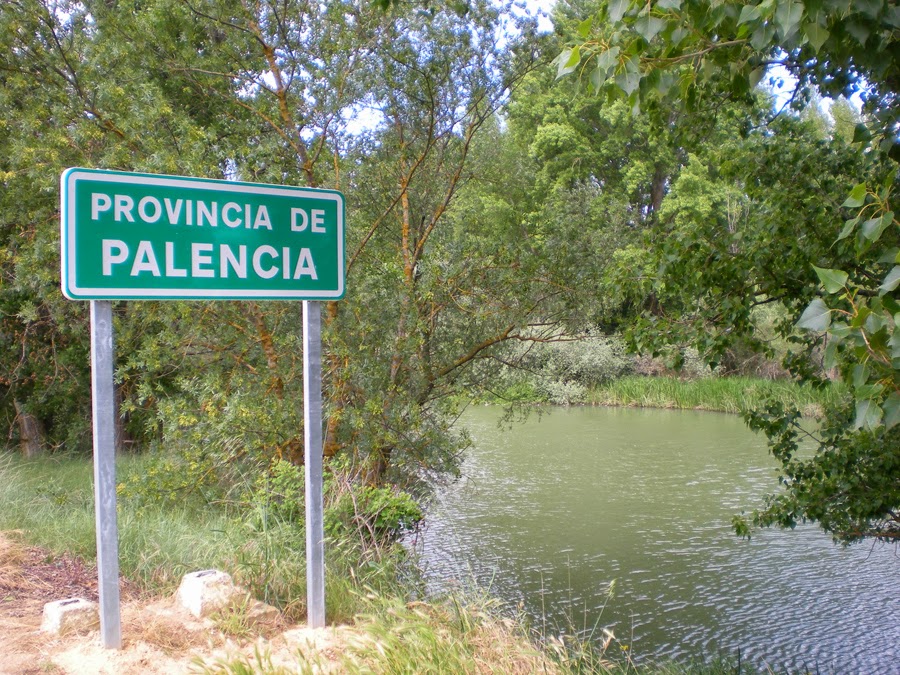
Rosa tells us how unusually cold the weather is this year, and then they both break the news that the bridge between the villages had been swept away years before – but there is a pretty path along the river to the main road which then becomes the Camino.  Cross the river there and we are in Palencia.  It proved a lovely walk, our encounter was pure serendipity and John decides not to throttle me.

to be continued ...

Z xx