Translate

Monday, September 29, 2014

Camino Twenty-One – O Epiphany! O Holy Grail!


I wander over to the little 8th century church with the intention of saying thank you to the memory of Don Elías Valiña Sampedro the rather saintly priest who painted yellow arrows along the entire Camino from Roncesvalles to Finisterre.  And then re-painted them when they needed it.  He may have invented the yellow cockleshell milestones too – but whatever he did I am fiercely grateful he did it.
I walk in to the church directly to the left chapel where his grave is.  Thank you’s said, I glance up to see a statue of St Benedict.  Father Bede made me an Oblate of St Benedict years ago in Shantivanam; St Benedict and St Francis appeal to me for being just laymen seeking holiness.  Not piety, which is pretentious, but holiness, wholeness, an integrity of living. 

I smile, and wander over to the other side chapel where, on the wall, is a splendid 11th century Virgin in Majesty.   There she sits, on her Throne of Wisdom, le Trône de la Sagesse, just as she should.  

Seeing her catapults my thoughts back to my research throughout France in the late nineties tracking down these wonderful images in response to Father Bede’s request that I do so, for him and for women.  I count my blessings: two great mystics have each taken me under their wings before I had wings of my own with which to fly:  Father Bede, Mrs Tweedie ... remembering what she told me of the timeless links in the Chain of Succession brings a prickle of tears to my eyes as I stand there.  The church seems incredibly warm suddenly, as if I am cocooned in a warmth not quite actual.

I look to my left.  There are people sitting and praying or simply gazing at an alcove in which is a glass cabinet displaying a patten, a chalice and two cruets.  I blink and go closer.  I can’t read Spanish but I do know the meaning of San Graal – a grail, “wondrous but not explicitly holy” and connected to the Arthurian legends but even more essentially to Joseph of Arimathea.  

What’s he doing here? I think, surprised.  The Glastonbury legend tells us Joseph of Arimathea came there after the Crucifixion, carrying two cruets which contained the blood and sweat of Christ ...  Goosebumps add to the prickling sensation I am experiencing, and with it a sense of dislocation. 

These things – St Benedict, Mary in Majesty, two cruets and a chalice said to be the Holy Grail – are powerful mnemonics of remembrance Past, almost Far Memory stuff.  All in one tiny church. 
 

I decide to leave, to ground myself with a hot chocolate after such an exertion of climbing.  I don’t reach the door.  On my right is a small side chapel and ever curious I go in – and I am undone.  In this empty, holy, place is a copy of the Cross of San Damiano, the Cross ever linked to St Francis.  Unbidden, tears flow down my face, I cry, these stones ... this remembrance ... I am overwhelmed by a flood of images that takes me back to last Christmas when I went for the first time to Assisi...  
 

Assisi - Christmas 2013: on my second day there the fog came down so thickly no one but me ventured out. I was alone.  The fog was so thick I struggled to see my hand at the end of my arm.  Santa Chiara, a vast, vast Cathedral, was completely invisible as I stood in the piazza by the fountain in front of it.  The fog was a white and silent duvet over the whole of Assisi but I couldn’t bear to waste time by staying in my room.  I ended up walking, climbing, a long winding road right out of the fog to the Eremi, the Hermitage.  It was a blessed choice.  A hoopoe flew overhead as I walked.   Farmlets were named Upupe, the Italian name for this pretty bird whose presence on other pilgrimages of mine highlit, for me, significant rites of passage.  A decade beforehand I had painted an icon of St Francis with a hoopoe – how could I have known then of its place in his forest?

Up at the Hermitage I was above the fogline; looking down I could see only a dense white blanket without even a church spire to suggest Assisi might still be there.  More than foolish, I took a path down through the forest from the Hermitage, my rationale being that it would be shorter than the long winding road; and in equal measure, it would have been the path St Francis walked. The fog had time-travelled me back 800 years...  Footfall by silent footfall I inched down through the forest in the fog guided only by keening my ears to the quarter-hourly sound of church bells far below me. 

The day before the fog came down, in the Cathedral of Santa Chiara, I found the Cross of San Damiano.  It is fundamental to the whole exegesis of the man who wrote the Canticle to Creation; surely the first Code for the care of animals and the whole earth.  The point of my divertissement here is that I went down to the museum in the crypt of the Cathedral and I was floored at the sight of the gown St Clare had made for herself when she left all to follow Francis, who wasn’t yet a saint.  It was mine.

I kid you not; I was even wearing something almost identical at that very moment.  I have always worn loose layers, tunics, over-garments, and this, this epiphany in front of me, was the prototype.  Now, I am no reincarnation of St Clare (or Cleopatra, or Mary Magdalene, she who walks the High Street of Glastonbury in clones, or Morgan le Fée  another commonplace clone in Glastonbury), but I swear to you that garment was mine.  

The stone steps to the crypt held my boots fast as I gazed at this mediaeval marvel in its glass cabinet.  It was a Goosebump Moment.  The garments of St Francis were there too, St Clare had made them all.  Slightly dazed, I left the Cathedral and walked down to San Damiano.  A sizzling sensation through the soles of my feet left me in no doubt I was walking in the footsteps of St Francis. It was only a slight suspension of thought to claim my place in the twelfth century.  San Damiano was a different epiphany moment, in this garden St Francis had written his Canticle praising Brother Sun and Sister Moon ... 

More was to come.  I continued to explore this tiny church where St Clare lived for over forty years, fell in love with the fresco of the Madonna above the altar, and was led up very worn stone stairs to come face to face with bronze statue of St Francis and – a Hare.  Oh my! 


A hare, another flood of memories ... the symbols of my own life were coming so thick and fast my brain couldn't travel that way, couldn't keep time.  

2012 was my annus horribilis.  I doubted I would survive it but I did, and its final transition and return to normality was dramatic.  One morning, after almost a whole year in a kind of stasis as the litany of events unfolded, I woke up completely free of their effect after two significant dreams, neither of which were relevant to what came next.  I was compelled to paint a hare

 I did.  The painting took me seven days and my revelation of the hare as a once sacred creature then took me to north Wales to the shrine of the Hare and of St Melangell, the 6th century princess turned holy woman for whom the Prince of Powys ceased hunting hares. 

 After my painting of the hare came a painting of a hoopoe.  I have never painted animals; I have barely ever painted anything.  

 They came, perfect and exquisite, a kind of blessing from the inner world where symbols sacred to our individual psyche abide.  In front of that bronze statue I knew I was in the presence of a mystery, it spoke through me, and it would continue to guide me. 

... and I haven’t even mentioned the synchronicity of my ‘chance’ meeting with a stranger named Mary in the Queensland Art Gallery in Brisbane – where I was metaphorically burying my daughter in October 2013 – who told me over coffee at a shared table in the Gallery café of a book she was reading on the life of St Francis which title lit up a flame of longing that I must go to Assisi ... 


Now, six months later, I am standing in an 8th century church in Galicia where St Francis has lived.

The girl at the reception desk of the church comes to me, sees how moved I am.  Did you not know this of St Francis? she asks, that he walked here, walked the Camino?  The Benedictine fathers who built this church gave it to him... For this year you can have two Compostelas, one to commemorate 800 years of St Francis.  We have even this credential ...


As I ponder all this the dear girl stamps my new credential of St Francis and St James, Santiago.  We are both teary.  We hug, bound by a common understanding of the magnitude of synchronicities and I go to sit and contemplate all these not-so coincidences over a cup of very hot chocolate.  There is yet one more surprise before my day ends.

To be continued ...


Friday, September 26, 2014

Camino Twenty – O Cebriero! O Epiphany!

The path was comfortable for some while; crumbly asphalt wound through tiny hamlets, a number of which offered horse riding as an alternative to walking the mountain to O Cebreiro.  I thought it a wondrous idea, but the notices proved carrots, always leading on to the next notice and promise and then the next – until I suspect one’s belief in their actually being any horses to ride ends up making one feel a complete ass! 

After Las Herrerias the path took on a different character altogether.  Now I was struggling with the ascent and the rocks and the slippery boulders as a whole lot of pilgrims attempted to jostle past me on the narrow defile. 
 There was a considerable drop on my right, over which I did not want to hurtle, and I held my place along the ascent with difficulty as faster pilgrims assumed a sense of entitlement.  I waited, immovable, while they changed to Indian file and passed me.  This same sense of entitlement astonishes me on high-hedged English country lanes too when cyclists blithely ride two or three abreast with no thought under their silly helmets of the possibility of sharing the narrow lanes.   There’d be a few less swipes in their direction from irritated motorists banked up behind them in second gear if they went single file.  I couldn’t safely go any faster, stood my ground, and bore the frowns.  Going single file through the defile interrupted their conversations!
 
At last the remaining morning rush of pilgrims from Vega and Ruitelán disappeared ahead of me and I could continue at my own pace, plodding along, stopping for breath every few minutes.  It was fairly dense but open-leaved forest here, no views but the rocks underfoot.  On and on I went climbing and climbing, only looking back down when I paused, not up or forward.  It was more than an effort and time seemed very slow in responding to my getting anywhere at all.   In due time I came out of deep forest and could see a couple of farm buildings with an arrow pointing straight and an arrow pointing right and saying Albergue de La Faba.  I went right, anything to break the intensity of the climb.
 
I am so glad I did.  I came to an eleventh century church and an albergue of exquisiteness and there in the courtyard stands that most famous of all famous pilgrim statues.  It was an enchanted space.  Pilgrims had already left and the hospitalero spent a few minutes talking to me of the history of the albergue of la Faba.  Try as I might I cannot recall the name of the princess who commissioned the statue – Fürstenberg? Württemburg? – my memory has hitched itself to a passing cloud.
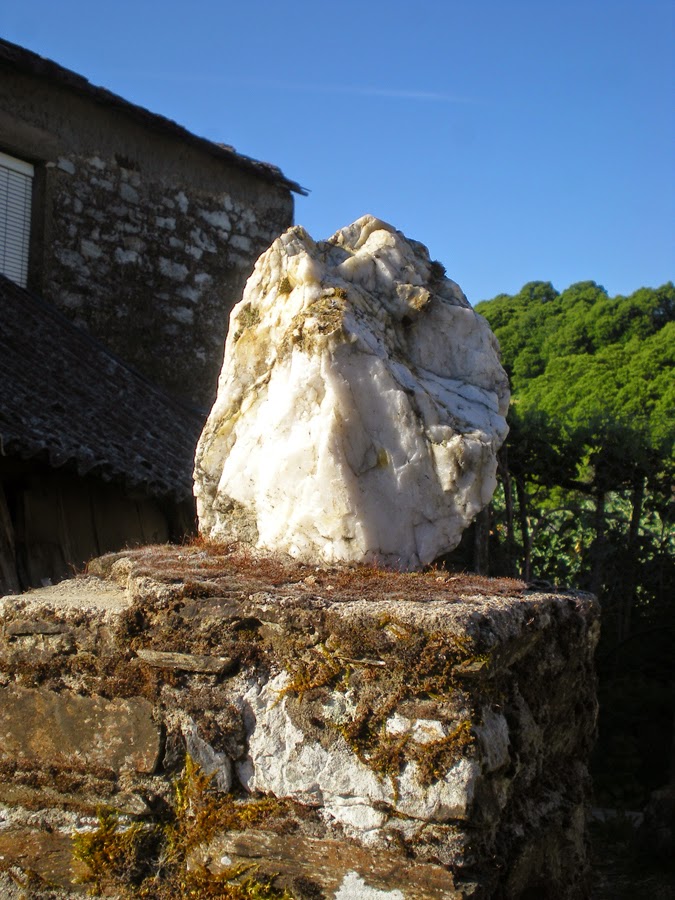
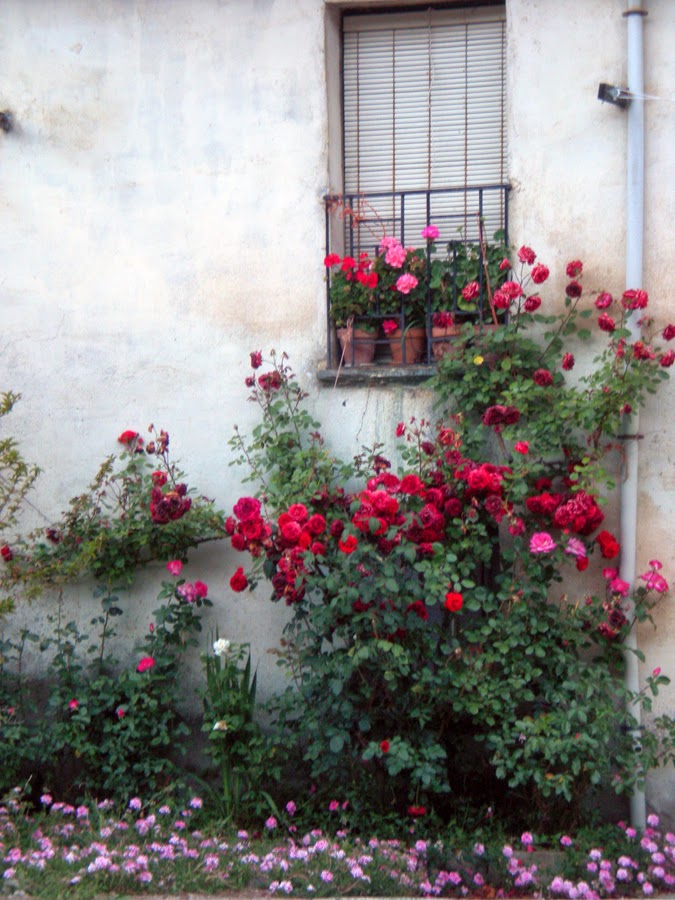
The pause refreshes me; I look at my guide profile, pretty impressive I reckon.  Another 300 vertical metres to La Laguna ... But now the scenery changes dramatically, I am on top of the mountains and the views unfold as I walk.  I see huge quartz crystals on farm gateposts, on roofs of houses, on old cattle sheds, purposefully placed.  A young man came out from an impressive house just as I am contemplating his climbing roses and believing the sign that comforts me with O Cebreiro 4 kms and I ask him why the crystals? 
I am not at all surprised when he says, surprised that I would need to ask such an obvious question: they bring down the light, conduct energies.  Earth wisdom here is not confined to esoteric books in the High Street, it is a genetic inheritance.  El Acebo and La Faba are quite my favourite secrets.
 
The road to O Cebreiro seems easy now; the quartz underfoot really does impart a charge.  I remember the first time I set foot on Magnetic Island I was dizzy for two whole days.  Quite discombobulated, I couldn’t shake the feeling off but on the third day it disappeared, my head cleared, and I’ve never felt it on there since.   The instruments of Captain Cook’s ship went haywire when he came close to the island, hence his naming it Magnetic.  The island is granite, and granite is a natural source of radiation; the granite on Maggie Island has huge amounts of quartz and walking on the island gives the same feeling of ‘bounce’. 
I am frequently amazed at how similar parts of the Spain I have walked through are to parts of the Australia I love.  Now I leave the village of La Faba the hills roll away from the eye, range on range, silhouettes of lilac, mauve, smoke, reminiscent of the valleys of Numinbah, Beechmont, Lamington, Binna Burra, Springbrook, beloved mountains, perhaps not so high, of the Great Dividing Range of southern Queensland.  I dawdle, entranced, all feeling of effort suspended.
I once had a dentist in Exmouth who disappeared for three weeks every year to walk.  One day I asked him where he went.  At that time walk for me was a four letter word; it was curiosity that prompted the question. You won’t know it, he said, it’s the most beautiful place in the world and it’s in Australia.  Try me, I replied and he said: Springbrook.  I laughed and said, you’re right, and I’ve a block of land up there near Purlingbrook Falls!  My book, Patrick and the Cat Who Saw beyond Time, is set right there on that magical plateau of mists and waterfalls, lookouts and spectacular bird life.
My reveries have brought me to La Laguna, the road is easy, winding up and up and beautiful beyond words.  Close to what I think must the top, well past La Laguna, I turn to grasp the magnitude of the 360 degree view and see just behind me the two Japanese legends I have kept on hearing other pilgrims speak of.  They are seventy-nine and eighty-one, or is it eighty-nine and ninety-one? At their great age it’s academic.  They seem tiny, slender, fragile figures as they hug the edge of the path coming to one of the crests. Beyond them I count seven mountain ranges, silhouettes fading to azure smoke in the skyline. 
The scene is almost unearthly in its beauty and burns itself into my heart.  The Japanese couple are doing the whole Camino.  Precious, I think and offer to take a photo of the pair of them with their camera.  They are delighted.  Not a word is recognised between us.  
 
Then – Galicia!  I have reached the painted monolith that marks the boundary between Castilla y León and Galicia!  I have come to the last of the provinces of the whole of northern Spain.  It is Galicia all the way now.  I am almost sad, I love this adventure in spite of being exhausted and in pain one way or another over much of my poor old bod much of the time!  But, no blisters!  And I have seen some horrific feet along the Way; many pilgrims are forced to drop out. As I stand at the milestone a young Italian offers to take my photo, and takes a couple of others for good measure with the views all around.  Who would believe me without these photos ... I can barely believe it myself.  And I remember Wolfgang of La Faba telling me Didier made it up in his wheelchair, he took the road, not the path of course, and Wolfgang drove him on to O Cebreiro.  How privileged I am to be able to walk these mountains ...  
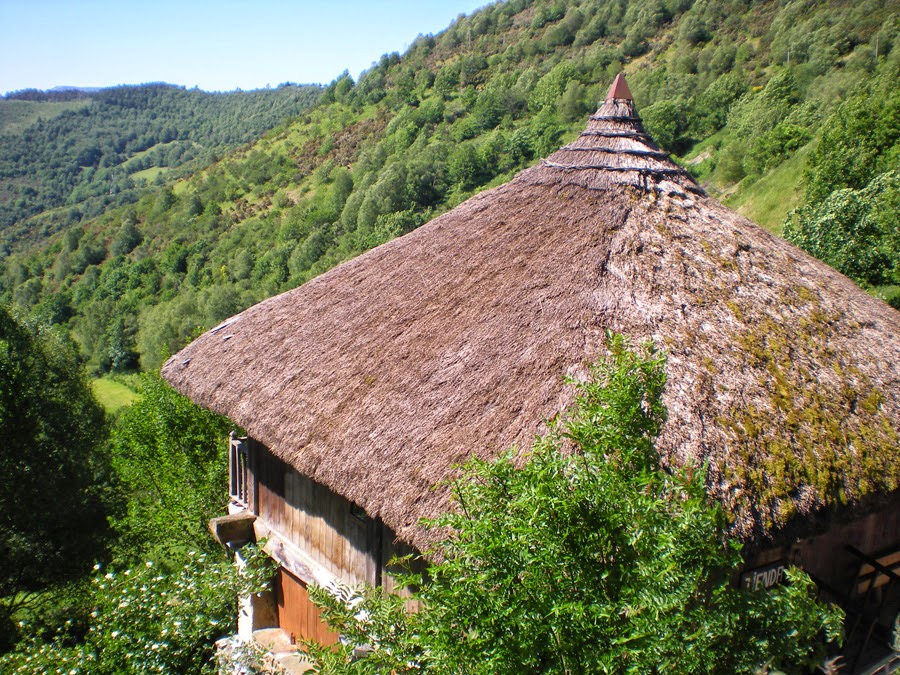
 And I enter the village of O Cebreiro.  I am charmed by the thatched roofs and round buildings, I imagine winter to be serious here at such heights.  
Chris is here, he suggests we have a coffee while he waits for his fellow walker and fellow driver.  We learn a little of each other’s lives, he loves cats and I am guided by a Ralph Cupboard sleeping on the window sill of a private house to seek for a room.  If I don’t find one, says Chris, as all appear full and I won’t stay in the albergue-of-snores in such a divine place, I can sleep in their car. 
The lady with the last private room in the village apologizes that it is pequeño frio, and by golly it is!  But it is ensuite, the bedding would satisfy the princess and the pea it is so thick, the wardrobe is stacked with even more quilts should I need them, the window is too high to look out of and I think that may be a pair of knees walking past.  No wonder the room is so cold, it is probably the wine cellar!  For my purpose it is perfect, and Ralph Cupboard leans against the external window alcove warming himself.  Cats along the Camino are not well treated as a rule, I’ve seen some sad ones along the way, and I stopped a man throwing a stone at a very pregnant and hungry mother cat way back, so to know my hostess has three happy ginger cats is a comfort.  An atmosphere charged with cruelty is a hard thing to abide in. 
 The huge key to my room is kept behind a baroque French enamel and ormolu clock in a niche in the salon wall.
Lunch is a succulent stew, meat, falling of the ribs of a rib cage so generous I wonder if they’ve unearthed an Auroch or two.  I wash it down with a small bottle of dry local cider which is crisp, thirst-quenching and delicious. A quaint tin cut out pilgrim sits by the wall of the hostel whose food is, I learn, legendary.
Full and happy and so proud of myself for climbing O Cebreiro, which doesn’t seem difficult at all now I am here in heaven, I go over to the eighth century church to say thank you – and I am undone ... but the Epiphany and the Holy Grail must wait to be told, for even Ezekiel’s response to his bizarre experience was to sit dumbfounded for seven days; a stretch of time proper for digesting a divine vision.

 To be continued ...


Wednesday, September 24, 2014

Camino – Nineteen – Buddha, Bedbugs and A Brave Climb to Contemplate

 
16th June
I am ready to leave.  I lay awake for ages waiting to hear the first pilgrims pass under my balcony from the albergues up the street as I have no clock to tell me the hour and don’t want to walk in the dark for too long.  I finish yesterday with a longish walk around the town and valley, came back to cut toenails and fingernails, wash out Everything, re-pack and have another luxurious bath. I sleep wondrously.
 It is 8 C and 6 a.m.  In twelve hours it will be 36 C.  Today I am off to Vega and Ruitelán, 20 kms, all trees and shade, a flat road and a river running alongside.  It is a beautiful walk along the N6; cherries hang well in reach as I pass laden trees and fill a small bag. 
Yet this walk has suffered another of John Brierley’s denouncements and dire warnings not to travel it.  Really that man!  When did he last walk the Camino?  Check for accuracy?  Wake up and get real?  Update his guide book? 
Telling tired pilgrims to walk the Dragonte or the Duro because he thinks these paths ‘more spiritual’ really is the limit!  Bitumen, according to JB who enjoys a good car that needs bitumen, is not spiritual.  Really?
 What of the birds, the trees, the ease of walking, the cherries, the river, the riversong, the coolness, the sheer pleasure of not having to puff and pant and lug one’s mochila up and down unendurable hills?  All this wonder of the walk along the N6 inclines one to pleasant thoughts, even spiritual thoughts.  I wonder what’s a ‘spiritual’ thought anyway?  Thinking about murdering a snorer or two is most restorative for my spirits!
And so I do walk along the N6 the whole way, it is under massive trees, serenaded with birdsong and the river runs alongside.  The river – with its other alphabet, murmuring from every ripple glimpsed through dense foliage, singing round every boulder, shimmering pink and dark slate from every reflection charms me. 
 I don’t find I’m thinking much at all.  
 Only two cars, Guardia Civil on a routine drive, pass me during the entire walk of many hours until at least the village of Vega de Valcarce, which is tiny and certainly not the stuff of spaghetti junctions.  All traffic has been re-routed along the triple by-pass of an autobahn hundreds of feet above this green and forested part of the Camino. 
 I catch glimpses of these soaring highways as the river valley road rounds its bends. 
 
 Four military men, their dog and a colourful flag, pass me in Trabadelo.  
I understand them to be helicopter pilots in the army, from the Basque country, but understanding in a language I don’t speak has moveable goal posts.  
 They are peregrinos, off to Santiago de Compostela, a gay sight indeed.
 
Foxgloves line the banks.  Ambasmestas has great coffee, strong and full-flavoured, organic says the barman who takes the most infinite pains to slice Serrano ham and Manchego cheese to make a bocadilla for my journey. 
 
 Vega del Valcarce is so tidy, like the spa town of Alet-le-Bains, probably with a similar population count reaching – three figures!  I continue to Ruitelán, population, 11?
I wait in the rose trellised courtyard garden of the Pequeño Potala.  Their clothes washing sink is outside so I wash my socks and hang them on the lines.  Registration will open at midday, not long to wait.  It is run on military lines by two men who may be more than friends.  
 One of them barks: Close the windows! Flies!  No Jacotrans now! Put All credencials here!  Do not go out this door, come in only, and only once!  Go out that door! And ALL pilgrims will eat together at 7.30 ... I demur at the last injunction, preferring not to eat late meals when I go so early to bed – to no avail.  Instructions are delivered with the terrific power of a Cerberus barking at the Gates of the Underworld.  I accept the reasons but find the machine gun delivery hard to bear after a 20 kms walk with nothing more disturbing than birdsong and wind in the trees. 
 It is a large judgement to make on two men I do not know and I am happy to be proved too hasty a few minutes later when another side to the military manners shines through.
In came a boy with bedbugs.  He had come from Villafranca, from albergue Refugio Ave Fénix which has a reputation for a distinct lack of hygiene since Jesus Jato died.  Carlos brought the boy outside to the rose terraces and gave him three huge plastic sacks to empty his belongings into and a set of clean clothes to wear after his shower.  Everything will be frozen overnight in a huge ice-cream deep freezer over in the hotel!  Freezing kills bedbugs.  Other albergues may well have turned away the Danish boy, but here in Pequeño Potala he is kindly received. Bedbugs are the scourge of all the refugios and hostels from St Jean Pied de Port to Finisterre; bedbugs are taken very seriously along the Way, and refugios can be closed for weeks during fumigation of an infestation.  Bedbugs are carried by pilgrims from one refugio to another.  
Celi translates this as I see the huge red weals of bedbug bites covering the boy’s back and arms.  I observe kindness and compassion now flow freely in this little Potala, a far cry from the peremptory welcome of an hour before.
As quite the Cat Who Walks by Herself I find the loud bonhomie of strangers around the dinner table uncomfortable.  I recognize my misalignment to the human race but know that hermits in pairs is more my line.  Like any good feline I sit quietly and neatly at the table, paws folded, closest to the food, a vast tureen of cream of carrot soup made from locally grown carrots.  Carlos asks me to serve it to all, perhaps sensing in me the truer comfort zone of doing something.  The meal that follows is superb, and all vegetarian.  The cacophony around me makes it easy to silently pay homage to this splendid meal.
17th June
A good night’s sleep in a small dorm with three other women, no snorers, windows wide open and at 6.30 a pop style rendering of Gounod’s Ave Maria wakes us, it would waken the dead.  We are invited to a marvellous breakfast of hot milk, muesli, real coffee, toast, rolls, jams, honey, boiled eggs, teas of all kind ... as much as one needed.  How do these two men do it day after day, night after night, year after year and all for €15?  Little Bodhisattvas of Pequeño Potala, thank you!
Today I face the one stretch of the whole Camino over which I have serious qualms.  I doubt about being able to climb – O Cebreiro.  It is only a ten kms walk but nine and a half of those kilometres are vertical.  I will climb 700 metres, that’s over 2000 feet, to reach 5000 feet above sea level.  These seem incredible statistics for someone who lives at sea level on the Somerset Levels!  I will give it a go.
I’m glad I left instructions for my Requiem Mass with Father James – just in case! 
I have passed so many crosses of pilgrims who died on the Camino I fully expect this climb to O Cebreiro to be the last time I put one foot in front of another on planet Earth!  One step at a time and don’t look up, I remind myself.
I check the Jacotrans label on my mochila one last time, tie my boots firmly, pick up my stick and, Gathering All My Determination, bid my farewells.

to be continued ...