Translate

Wednesday, September 24, 2014

Camino – Nineteen – Buddha, Bedbugs and A Brave Climb to Contemplate

 
16th June
I am ready to leave.  I lay awake for ages waiting to hear the first pilgrims pass under my balcony from the albergues up the street as I have no clock to tell me the hour and don’t want to walk in the dark for too long.  I finish yesterday with a longish walk around the town and valley, came back to cut toenails and fingernails, wash out Everything, re-pack and have another luxurious bath. I sleep wondrously.
 It is 8 C and 6 a.m.  In twelve hours it will be 36 C.  Today I am off to Vega and Ruitelán, 20 kms, all trees and shade, a flat road and a river running alongside.  It is a beautiful walk along the N6; cherries hang well in reach as I pass laden trees and fill a small bag. 
Yet this walk has suffered another of John Brierley’s denouncements and dire warnings not to travel it.  Really that man!  When did he last walk the Camino?  Check for accuracy?  Wake up and get real?  Update his guide book? 
Telling tired pilgrims to walk the Dragonte or the Duro because he thinks these paths ‘more spiritual’ really is the limit!  Bitumen, according to JB who enjoys a good car that needs bitumen, is not spiritual.  Really?
 What of the birds, the trees, the ease of walking, the cherries, the river, the riversong, the coolness, the sheer pleasure of not having to puff and pant and lug one’s mochila up and down unendurable hills?  All this wonder of the walk along the N6 inclines one to pleasant thoughts, even spiritual thoughts.  I wonder what’s a ‘spiritual’ thought anyway?  Thinking about murdering a snorer or two is most restorative for my spirits!
And so I do walk along the N6 the whole way, it is under massive trees, serenaded with birdsong and the river runs alongside.  The river – with its other alphabet, murmuring from every ripple glimpsed through dense foliage, singing round every boulder, shimmering pink and dark slate from every reflection charms me. 
 I don’t find I’m thinking much at all.  
 Only two cars, Guardia Civil on a routine drive, pass me during the entire walk of many hours until at least the village of Vega de Valcarce, which is tiny and certainly not the stuff of spaghetti junctions.  All traffic has been re-routed along the triple by-pass of an autobahn hundreds of feet above this green and forested part of the Camino. 
 I catch glimpses of these soaring highways as the river valley road rounds its bends. 
 
 Four military men, their dog and a colourful flag, pass me in Trabadelo.  
I understand them to be helicopter pilots in the army, from the Basque country, but understanding in a language I don’t speak has moveable goal posts.  
 They are peregrinos, off to Santiago de Compostela, a gay sight indeed.
 
Foxgloves line the banks.  Ambasmestas has great coffee, strong and full-flavoured, organic says the barman who takes the most infinite pains to slice Serrano ham and Manchego cheese to make a bocadilla for my journey. 
 
 Vega del Valcarce is so tidy, like the spa town of Alet-le-Bains, probably with a similar population count reaching – three figures!  I continue to Ruitelán, population, 11?
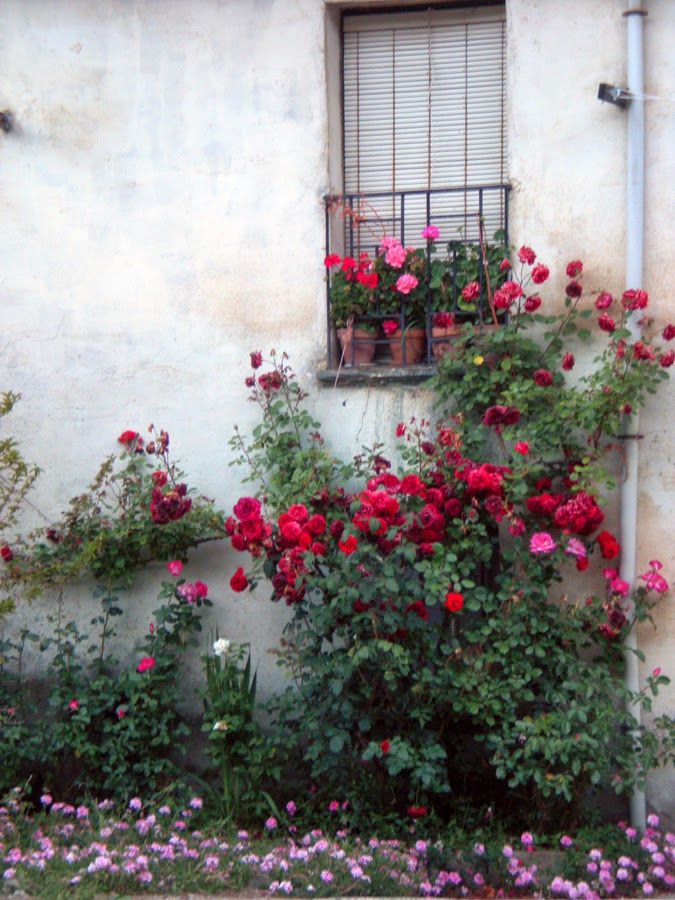
I wait in the rose trellised courtyard garden of the Pequeño Potala.  Their clothes washing sink is outside so I wash my socks and hang them on the lines.  Registration will open at midday, not long to wait.  It is run on military lines by two men who may be more than friends.  
 One of them barks: Close the windows! Flies!  No Jacotrans now! Put All credencials here!  Do not go out this door, come in only, and only once!  Go out that door! And ALL pilgrims will eat together at 7.30 ... I demur at the last injunction, preferring not to eat late meals when I go so early to bed – to no avail.  Instructions are delivered with the terrific power of a Cerberus barking at the Gates of the Underworld.  I accept the reasons but find the machine gun delivery hard to bear after a 20 kms walk with nothing more disturbing than birdsong and wind in the trees. 
 It is a large judgement to make on two men I do not know and I am happy to be proved too hasty a few minutes later when another side to the military manners shines through.
In came a boy with bedbugs.  He had come from Villafranca, from albergue Refugio Ave Fénix which has a reputation for a distinct lack of hygiene since Jesus Jato died.  Carlos brought the boy outside to the rose terraces and gave him three huge plastic sacks to empty his belongings into and a set of clean clothes to wear after his shower.  Everything will be frozen overnight in a huge ice-cream deep freezer over in the hotel!  Freezing kills bedbugs.  Other albergues may well have turned away the Danish boy, but here in Pequeño Potala he is kindly received. Bedbugs are the scourge of all the refugios and hostels from St Jean Pied de Port to Finisterre; bedbugs are taken very seriously along the Way, and refugios can be closed for weeks during fumigation of an infestation.  Bedbugs are carried by pilgrims from one refugio to another.  
Celi translates this as I see the huge red weals of bedbug bites covering the boy’s back and arms.  I observe kindness and compassion now flow freely in this little Potala, a far cry from the peremptory welcome of an hour before.
As quite the Cat Who Walks by Herself I find the loud bonhomie of strangers around the dinner table uncomfortable.  I recognize my misalignment to the human race but know that hermits in pairs is more my line.  Like any good feline I sit quietly and neatly at the table, paws folded, closest to the food, a vast tureen of cream of carrot soup made from locally grown carrots.  Carlos asks me to serve it to all, perhaps sensing in me the truer comfort zone of doing something.  The meal that follows is superb, and all vegetarian.  The cacophony around me makes it easy to silently pay homage to this splendid meal.
17th June
A good night’s sleep in a small dorm with three other women, no snorers, windows wide open and at 6.30 a pop style rendering of Gounod’s Ave Maria wakes us, it would waken the dead.  We are invited to a marvellous breakfast of hot milk, muesli, real coffee, toast, rolls, jams, honey, boiled eggs, teas of all kind ... as much as one needed.  How do these two men do it day after day, night after night, year after year and all for €15?  Little Bodhisattvas of Pequeño Potala, thank you!
Today I face the one stretch of the whole Camino over which I have serious qualms.  I doubt about being able to climb – O Cebreiro.  It is only a ten kms walk but nine and a half of those kilometres are vertical.  I will climb 700 metres, that’s over 2000 feet, to reach 5000 feet above sea level.  These seem incredible statistics for someone who lives at sea level on the Somerset Levels!  I will give it a go.
I’m glad I left instructions for my Requiem Mass with Father James – just in case! 
I have passed so many crosses of pilgrims who died on the Camino I fully expect this climb to O Cebreiro to be the last time I put one foot in front of another on planet Earth!  One step at a time and don’t look up, I remind myself.
I check the Jacotrans label on my mochila one last time, tie my boots firmly, pick up my stick and, Gathering All My Determination, bid my farewells.

to be continued ...


Tuesday, September 23, 2014

Camino – Eighteen – Rest, Reflections and a Revelation in Villafranca del Bierzo

 
Hours later hunger compels me to dress and look for food.  I am thoroughly taken in by a touting restaurateur and led down into a dungeon off the main square.  The square is bright and full of happily dining people, why don’t I stay and eat here?  But it is a weak moment and I am now semi-blind, my eyes hurt, my legs hurt, I suppose I want to be cared for, coddled, and not have to make a decision as to where to eat. 
 I order, but am given mussels not mushrooms, the main course is a mediocre something, and I am overcharged on my debit card by a rather large amount, fifty percent in fact, but I am too blind and cramped to register it until back in my hotel and horizontal. Once home in my room I lay on my bed, dealing mentally with the man, too unwell to go back and right the wrong.  As the only deliberately negative experience along the entire Camino I decide to let it be.  I can’t even recall the name of the place to shame him in print forever.
 
At night the 36 C drops to 8 C and the radiators go on.  I am cosy and warm, and welcome the thick blankets which I had earlier pulled off.  In the morning my eyes are normal and I watch pilgrims going spritely down the street, but I will stay another day, let my legs return to normal.  I buy organic kefir and peaches, full, sweet and dripping with juice, the like of which I haven’t tasted in decades – these have been allowed to live out their allotted span to reach perfection on their trees in the sun. 
Cherries I still have from the trees along the way, and I add a delicious organic gazpacho soup to my purchases, made by, so the packet tells me, Saint Teresa.  The little grocery store on the corner of the plaza has everything delicious and I indulge in the breads and cheeses too.  It is owned by a woman who seems to care much for her produce ...
 
As I cross the plaza I meet the cheating restaurateur – he has the grace to squirm under my gaze and scuttles down the lane back to his dungeon!  Why! I think, not entirely surprised at his rapid disappearance, he knew what he was up to and guilt has caught him.  I’ll bet he thought I’d be gone in the morning with every other one-night-pilgrim who passes through Villafranca ... but here I am, standing here as large as his guilt!  I’m rather pleased that I didn’t return to chide him by quoting Papal Bull, Book and Candle for stealing from a peregrina!  What did a friend once say: karma is never cruel but it is uncannily accurate!
I woke in a low moment actually, one of those moments of self-doubt and feeling – I dislike the word but it suits – ugly.  Flashes of Mother’s Mantra you are fat, you are stupid, you are ugly ricochet around my head. Funny how it surfaces to hit me in the face, so to speak, when faced with a mirror.  I console myself with the thought that Pericles apparently felt the same about the shape of his head too, and concealed it for posterity to remember him by always wearing a shining and handsome helmet.  We, Pericles and I, share a keen sense of democracy and fair play – small coin for a woman who, when all is said and done, would just love to be pretty and loved. I smile at the comparison and know that I have, at least, a shining and beautiful humour.
Downstairs I meet Ann from Brighton, we had met at Gaucelmo.  She stayed last night at Cacabelos for €5 and found the place beautiful, only two beds in each room, she tells me, and the rooms are built in a horseshoe around the church. I felt worse then as I had told myself to stay there, marked it in my Michelin Guide.  Walking on to Villafranca cost me my eyes, my legs, and €60 for two nights in San Francisco! A CD of songs by Loreena McKennitt is playing in the café; I share with Ann the breathtaking youtube film by Hikmet Sesinoy, a Chechnyan whose wild mountains, dancing men, fleet-hooved horses, flying hawks and exquisite women, lifts McKennitt’s song Night Ride Across The Caucasus to a level of pure enchantment. 
Ann notes it in her diary, will watch it when she gets home.  I walk with her to the edge of town, we hug goodbye, she looks at my feet: they don’t look like they’ve walked any distance at all, she laughs, they’re beautiful!  I laugh too, I only told them they were beautiful this very morning, I respond, as Ann hugs me again and adds, out of the blue, and you are beautiful too, Zoé.  I know a shadow passes my face; I nod, tell her I probably needed just those words just this morning, thank her, and watch as she walks down the pilgrim path and over the bridge.  She has chosen to take the mountain path of the three available out of Villafranca.
Following the road I continue to a café for café con leche, ponder on how timely things are, how right things just happen when the heart cries.  I pass a very large building and glance up, aware of a huge poster hanging on its wall.  Something calls me across the road to look up and I strain to read it.  Good Heavens!  This Revelation is telling me that St Francis was here in 1214, 800 years ago.  Is it possible?  I didn’t know that and I’ve read much of St Francis and furthermore I spent ten days in Assisi over Christmas and no one told me anything about Saint Francis on the Camino then.   
Mind you, no one who is Christian knows he spent two years with Sultan Malik al-Kamil either, not trying to ‘convert’ him – really, people are so self-congratulatory – but sharing like with like as men of God.  Sultan Malik, the nephew of the great Kurd, Saladin, whose exemplary behaviour towards even the worst of the barbarous Crusaders shames us now, was something of a mystic, and great souls recognise each other.  
In the time it takes to photograph the poster all these thoughts run through my mind; am I re-tracing footsteps of past lives?  I have my own Kurd stories and I ponder on the fact of my being here at all.  Am I rounding off karmic circles?   Completing things?  I’ve led such a strange life, been so obedient to its inner dictates. 
In the comfort of my journal I write the story of St Seraphim in his forest; a woodman or someone comes to him for spiritual advice and said Father Seraphim I can hardly look at you, your face is shining like the sun, the light dazzles me.  Saint Seraphim placed his hands on the man’s shoulders and said you can see me like this because you are lit by the same dazzling light.   
As a man is, so he sees.  Blake said that about men chopping down trees too.  It’s almost a commonplace; we see in others what we are, or what we potentially are.  Such a comforting thought, one day I’ll be nice in spite of Mother’s Mantras!  I like nice people!  And then I remember Father Bede, who stayed with me shortly before he died, telling me I had the consciousness of the Holy, and that I must continue his journey to the Black Madonna for him and for women.  These are mighty thoughts for a morning.
I return to the Pilgrim Bridge and photograph the striding stone peregrino just as the three Americans arrive.  They are such nice men, we meet and pass from time to time but now we stay awhile and talk, they too are having a rest day as one of them suffered from the boiling walk yesterday.  Two are walking, the third is unable to and drives a car to meet them at their hotels each evening.  They are diplomats, one is based in Paris at the American Embassy, they have walked together many times over the years.  They tell me they have ditched their John Brierley – dreadful book, say two of them, found the guidebook of Alison Raju and admire her intelligence.  We chuckle again and Chris points out the easiest of the three possible roads out for tomorrow.  
 The Dragonet, or is it the Dragonte, is not for me, nor the Camino Duro thank you; their names are enough to deter a tired peregrina.

 
I wander back to the mediaeval part of town and up to the Door of Pardon, Puerte de Perdón, where in days gone by pilgrims who were too ill to continue on to Santiago de Compostela would be cleansed of their sins by touching the door.  I too touch the door and a great sigh escapes me.  I’ll deal with my sins later.  But for now I think that being here and not in Cacabelos is exactly where I am intended to be or I would not be aware that I am following Saint Francis’ footsteps.
To be continued ...


Sunday, September 21, 2014

CaminoSeventeen – A Couple of Saints, A Knights’ Castle and Squirrel Nutkin


Apóstol Santiago is charming.  Pine cathedral ceilings, spotlessly clean old timber floors and the promise of an evening meal and breakfast.  After showering I sit by the roses on an old stone wall.  The stones are cool after walking in the high 20’s for five hours over two mountains.  I find somewhere to eat and have trout stuffed with ham and my ambrosial nectarines later. 

Passing Korean pilgrims, terrified of the sun’s rays on their skin, are dressed in sub-arctic wear.  Last night in the dorm one Korean tried to shut the window closest to me. No! I say, leave that window open! We are twenty two people in this room and we need fresh air. “Open?” he quivered, “all night?” And he donned his arctic wear to wear in bed!  At dinner last night he had told us the temperature would reach 40 C today – as he zipped up his thermal jacket.  Michael took one look and burst out laughing. 

No one is in the bunk above me but it seems everyone else in the albergue is hunching up to my end of the three dormettes because they’ve all experienced another Korean as a killer snorer.  This pilgrim has been left in a roomette on his own because of it!  There are only eight of us and beds for twenty-three.  I would have been alone but for the snorer ...  Oh well.  No one in my section snored – but sod’s law prevails.  I climb up to the top bunk as no one was above me and lay by the open window, a deep structure set in the two foot thick stone walls, to catch the breeze and have a moon bath.  I didn’t need earplugs until – oh the cats!  I lay listening to the huge new timbers of the old house creak and crackle and settle in the cool night air – and then the cats howl.  Like banshees they are, gathering from all quarters of the village, right under my window which is covered with stiff wire mosquito netting so I can’t pour my water out on to them.  I confess howling cats under the window or on hot tin roofs are more than even the most dedicated feline aficionado like me can bear.  Meanwhile the Korean snores on in the first roomette, counterpoint to the cats’ descant.

Breakfast is a bowl of hot milk, or coffee, and a slice of bread and jam.  Last night’s dinner was a bowl of spaghetti unrelieved by sauce ... glad I lunched well.


So I leave Acebo, noting a photo on the wall that shows it completely under snow during winter – no Camino then.  It is a very picturesque place. 

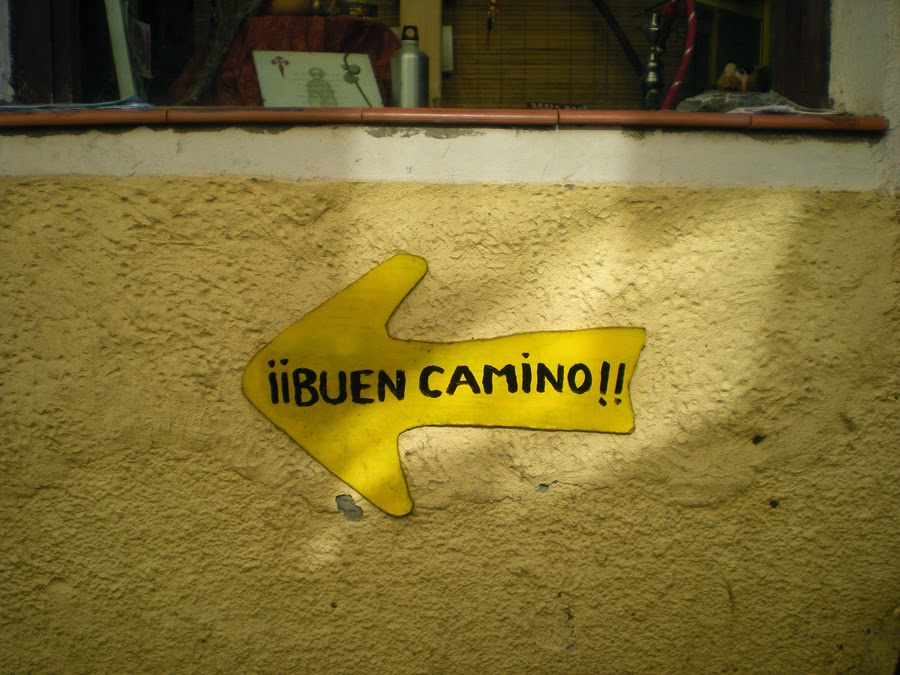
 On I walk to Riego de Ambros, a gingerbread village of tumbling old cottages and roses and the road disappears  where the yellow arrow points me right and then left.  There is no path.  I look somewhat aghast at the river bed, the yellow arrow is directing me down this raw river bedrock. 


 It is perilous.  I descend foot by inching foot, suddenly conscious of my feet and their history.  Goodness I don’t want to fall here – it is a hidden place and I am alone.  I walk with my walking stick propping me, placing my feet sideways on the steep rocks.  I slip, all goes flying, and the weight of my mochila hurtles me into the high banks of broom and brushwoods.  I manage to get up, pick up the walking stick and burst out laughing at the irony of everything – mostly the walking stick story.  Willa’s walking stick – and therein hangs a tale to tell at the end of my Camino.  I shake it heavenwards laughing as I thank her for being such a bitch that I now have her walking stick and it has saved my fall! 

I continue down, down, down this dramatic and dangerous descent with no views and no end in sight until at last the narrow river bed opens out to wider softer earth.  The scent of fox, and I startle a mole running blind to find his hole.  It is the third or fourth mole I have seen along the Way, scurrying blind to find its home. 


A café in a field – welcome sight.  A very rude NZ man arrives demanding coffee, hot toast – I said hot toast – he snarls – with butter, now as the pretty lone young woman was making my scrambled eggs and coffee.  A vulgar queue jumper, he was oblivious to me, the young woman, and the scenario.   I said excuse me ... attempting to salvage both my scrambled eggs and the young woman’s confusion – she dropped everything at his rude demands – and the man turned and told me I should relax and enjoy the Camino experience.  His sort beggars belief.

Ponferrada.  I’d only walked sixteen kms but such a difficult walk made me ache all over, I have descended one thousand metres, and Ponferrada is boiling at 36 C.  There are no hotel rooms to be had.  I sit in the foyer of one and weep with exhaustion.  The kind receptionist gives me two glasses of water and rings the albergue which I couldn’t find.  Yes, plenty of room, they tell her, though I dread another dorm and sleepless night.


On I walk to the splendid  Saint Nicolas de Flue. We queue in the foyer by a fountain for tired feet, some pilgrims are sitting on its wall doing a thing so sensible that I wrestle with myself for not being able to do the same – dangle my hot feet in the cold water while reading a book or chatting... I’m so not good in crowds!  The hospitalero takes me to a room of four where I am given a bottom bunk – the small wing was for women; marvellous. And Nicolas de Flue?  


He was a Swiss saint circa 1400 honoured by Catholics and Protestants for the permanent national unity of Switzerland, apparently he survived for nineteen years with no food other than the Eucharist.  A farmer, he was illiterate, and a visionary of considerable insight.  I send up a prayer of gratitude – this is a grand albergue, with good facilities. 

In came Martine, a Frenchwoman.  She is in much the same state as I, exhausted and momentarily tearful.  She is 65, has walked from Arles, with knees.  From Arles!  A mere 1450 kms, no wonder her knees are complaining.  Showers do wonders for both of us and off we go to find sustenance.  She joyously splashes her face in the cool water of a street fountain. We late-lunch together; a gracious man in Restaurant Templarios will offer us a large mixed salad – the restaurant is closed  for the afternoon and the chef has gone home but we can see he pities us old women!  An American woman follows us in, sits with us, and demands x y z from the menu.  We, embarrassed because she appears to be with us, tell her the restaurant is closed and the owner is graciously giving us a mixed salad, not a menu, eat it or don’t.  She demands from him, he looks puzzled, repeats what he can offer, she is rude,  and she gets up and leaves, she doesn’t want to eat any of that, she says, looking scornfully at our wonderful salads. 

Martine says she has met her earlier on the Camino, says she hates pilgrims, albergues and much else, only stays in hotels and Martine wonders what the Camino will teach her.  

Grace isn’t one of the lessons to date.


I am taken with the castle, though I prefer old monasteries, but once more I am particularly charmed by the public sculpture.  A vast wisteria spreading along whole blocks of old houses is supported by an ingenious series of bronze sculpted ‘roots’ from its span to the ground. 

I am impressed by the imagination and by the generosity of public funding to allow its creation.


14th June to Villafranca – the hottest day, the worst day and a 24 km walk.

The ugly man from NZ walks ahead of me as I leave.  Actually he is a good looking man, but like many of his type was obviously told so by his mother and the demands he makes on the world to fall at his feet can likely be laid at her feet.  How many good looking men have been thus ruined!  His wife is limping and I soon pass them along the pretty river walk.  He quips: iggs ind baycon this morning thin?  And I respond lightly with: not if you’re queue-jumping again which sets his face in stone.  I ask his wife about her knee.  She is quite unaware of her husband’s rudeness of yesterday.  She and I chat merrily, take a couple of photos of a painting of Our Lady of the Camino on the outside of a church, while pretty boy fumes.  I smile; I can be cruel!

The air is filled with the intoxicatingly heady scent of long avenues of flowering tilleul, linden, lifting my residual tiredness from another disturbed night’s sleep.  No snoring, but our windows opened on to a bus stop on the street and the full moon brought forth the sleepless of Ponferrada to gather there and discuss how to develop their Templar Castle into a theme park – or something.  Then, suddenly, to my surprise and delight, I notice a red squirrel ripple down a tree trunk; I see his long ear tufts russet glowing in the dawn light.  I photograph and wait, he reaches ground, turns, sits up, crosses his rufus paws across his white bib and I photograph again.  Distant and out of focus, but Squirrel Nutkin all the same.


I meet Joy from Wollongong, a town I once lived in, a town D.H. Lawrence once lived in, a town close to the great Royal National Park, Australia’s first, and the second in the world, declared protected in 1879.  Joy is 75, small, wiry and fit.  We have café con leche, she gives me a yoghurt which in this heat won’t keep, and we walk a while together.  Further on we stop at a cool way-stop under trees with plenty of water, I wet my scarf and drape it over my shoulders before I trudge on to Villafranca.   The bitumen of this stretch of road reflects its heat back to me and, though I do not yet know it, the temperature will reach 36 C by 6 o’clock this evening.  I am struggling.  The church albergue of Cacabelos looks marvellous, I have marked it in my Michelin for its recommendations, but it is too early for it to open and I decide to continue on to Villafranca del Bierzo.

The trail of pilgrims shows us all suffering along this stretch. A hill looms ahead, I attempt to hitch hike.  Of course no one stops; other pilgrims are doing the same!  It is an endlessly weary asphalt walk with little shade – I have seven kms to go.  There is no sign of the town, not at all.  Then down steep cobbled lanes to outdo Clovelly there is – Villafranca.  But something terrible happens to my eyes – they are stinging, tears are streaming down my face and I cannot see.  I cannot see at all!  I’d wet my scarf and so wash my eyes – it is horrible, I simply cannot see.  


My feet are cramping and my heel feels bruised – I lurch into a human, a young Spanish man as it happens, and he takes me by the arm down the steep cobbles, slowly, and with great concern leads me to the doors of Hotel San Francisco. He leaves, and the receptionist leads me upstairs to a room.  My eyes burn like coals and my legs are rigid.  Even stretching, which I mostly forget to do, hurts too much.  But, no blisters.  A shower first, in a bath with a wondrous wide shelf to sit on, and then horizontal.  Feet up, legs up, I rue having eaten my cucumber or I’d have put slices of it on my eyes.  I cannot open my eyes, but I rest in the bliss of cool cotton sheets, a breeze from the balcony and I decide to stay two nights.  My hair is silently turning greyer by the minute in protest at the shock to my body of doing half marathons at my unfit age. 


The significance of San Francisco, Saint Francis, will slowly dawn on me.  There are no accidents.

To be continued ... 


Monday, September 15, 2014

Camino Sixteen – The Last of the Wild, Wheelchairs and an Unlikely Banana!


Rabanal is a minute hamlet.  I buy food at Miriams, come back to the albergue and make a healthy bowl of provisions, am not allowed a dribble of olive oil, but given a bottle of cooking oil by one of the two male hospitaleros.  I sat at the al fresco table where the two male hospitaleros and the real olive oil sat and dressed my salad with it when the men were pre-occupied with young peregrinas; just because.  
Then I learn of cold showers – the plumbers have been working all day. Regardless, I wash Everything and me, hang my clothes on the long lines in the hot sun.  I love being here on English grass with bare feet and clover and patches of wild flowers under the silver birches.  The garden is a blessed sanctuary. 
 Susanna is a delight – the two men ... ah well.   At lunch I had tried to lead the table talk but it fell away in trifles and though I may have missed the currant cake I couldn’t help but notice the undercurrents.  The Australian is a far cry from enlightenment!  He disparages Dane, whom he hasn’t met, Dane is staying at a different albergue, his cello, and the entire canon of classical music.   Dane’s fame travels before him, he is playing in the old 11th century church tonight. The Australian was equally disparaging of the kindness of Marion of the CSJ too – she doesn’t make the rules, she’s not a hospitalero, it’s nothing to do with her, he grates in response to learning of my original email to her.  I just may pass that on.


A little back-story:
When I was panic-planning my walk at 4.00 o’clock in the mornings BC, Before Camino, I had emailed the Confraternity over their inflexible ruling that no pilgrim will be permitted refuge who has not walked and carried his or her pack up that 20 km hill.  Now, my feet have a history and so I wrote to the CSJ that the rule was fine for a twenty year old male, but not for a nearly-seventy-year-old woman who had been in a wheelchair and told she would not walk again. The one size rule really doesn’t fit all.

Some years back, when I lived in S.E. Queensland, I had tripped on the bottom stair of my verandah – and both feet had crumbled.  Just like that.  The verdict of the Australian medical fraternity who viewed the collapse of both my feet from such severe osteoporosis was rank dismissal – it was wheelchair for me.  No physio was offered, no options except wheelchair – forever.  Up till that moment osteoporosis had not been detected – although, at around the same time, I had a tooth removed and a piece of honeycombed jawbone came with it.  It puzzled me, but the negligent dentist of the day didn’t actually enlighten me as to why half a honeycombed jawbone would have come out attached to the tooth, a tooth which showed no signs of decay.
But back to my foot story:  a chance reading of a local newspaper during my months of bed confinement drew my attention to the arrival of a Chinese physiotherapist who set up practice at the bottom of my street.  Australia is a Very Large Continent.  The bottom of my street isn’t mentioned on the maps.  Yet Homer Lam came to the bottom of my street. Mark this for a miracle.

Something demanded I make an appointment to see him.  There is nothing so sad as lying listening to the silent sound of bones crumbling.  I was wheeled down to see him.  Four months had passed since I had been dismissed by the worthy members of the AMA.  When Homer opened the door he took one look at my feet, the left one was now an unpretty mottled blue to the ankle, and said gaily: oh, you have Sudeck’s Atrophy, I think I can help you.  And so he did.  How he did is a long story of three times weekly visits for nearly a year.  What he did is yet another story, and not for here.
It took nearly four years for me to be able to walk without thinking how to place my foot over, say, a sand ripple or a tussock of grass, anything that required the foot to bend itself. I had to retrain my cellular memory, the cells of my feet, in how to walk by thinking for them.  I can walk more or less without thinking over any terrain nowadays, but I am still cautious over uneven and serious rockiness underfoot, thinking each footfall in that nanosecond before making it.
The miracle of Homer coming to the bottom of my street is amplified when I tell you that this young man, he was 32 at the time, had a clinic in Hong Kong specializing in Atrophy. Why? you might ask.  And I confess I didn’t ask.  However, logic and a little historical fact suggests to me that with their centuries long history of foot binding and shattering bones to do so, Chinese women of older generations were/are still susceptible to osteoporosis in their ancestrally weak foot bones. Foot bones are fragile and thin at the best of times.  It would be generations après footbinding before the inherent and intentional weakness would have bred itself out.
Homer had applied to three universities for post doctoral studies: one in America, one in Canada and one in Australia – St Lucia, in Brisbane.  St Lucia answered him first, offering what he wanted.  Brisbane is at least 40 kms from where I lived in Silkstone, probably more. 

Imagine 40 kms as a radius point from Brisbane.  Now swing your mental compass in a huge circumferential arc and you will have a vast area of urban possibilities in which to set up, particularly as he lived in another suburb of Brisbane a long way from his clinic. Enough said.  That he specializes in the very thing that confounded the AMA medics and rendered them incapable of helping me is simply jaw-dropping don’t you think?  I call all the imponderables that make up my meeting him, a miracle. 


I emailed him BC to ask if he thought I could walk 500 miles with my feet.  Of course you can, he emailed back, only you, your feet will do well.  I suspect when my feet reach Santiago, having carried overweight me and overweight mochila, they will be stronger than they have ever been in their whole life.
Back to my email of now:
Thus, I emailed Marion to suggest that rules of one size do not fit all.  I had nightmares of struggling to reach ‘home’ and mother-tongue and soft green grass and tea on the lawn and being turned away because I may have resorted to Jacotrans.  Marion responded by emailing the hospitaleros to alert them to my coming and asking to let me stay.  Susanna welcomed me, to my delight and her congratulations, I had indeed carried my mochila all the 20 kms.  But, and now I return to the present, this rabid little Australian would have had no compunction in turning me away from my mother-community had I not fitted his rule book and arrived sans mochila on my back ...
I mull over his ungraciousness for three minutes before ditching the thought; the garden and the roses and the old stones in all their loveliness redeem all.
Tea on the lawn at 4.30 but no cucumber sandwiches – ah! English standards are slipping. I’ve been to vespers.  The remarkable Frenchman in the wheelchair is there, his hands black from the rubber wheels and blue with bruising.  What courage and determination ...  


A steep climb tomorrow, 1500 metres – 4500 plus feet – to Cruz de Ferro.  I can hardly believe I am here.  I can lay down Joe’s rock at last.  He walked the Camino last year, and asked me to bring a rock from his garden to place with the millions of others at the Cruz de Ferro, with prayers for his family and prayers for England.  I have carried it all the way!
Acebo: 12th June 2014:
Very hard walk on shale, protruding vertical bedrock, many climbs, very high, on and on and on. It was quite hard.  Really.  And the second hot day, high twenties. I arrive at Acebo at five minutes to two, am the first to stop at the lovely restored albergue of San Apostal Santiago, by the abandoned church on the way out of the hamlet.
Pedro lets me in. I choose a bunk next to a window, boots and mochilas must be left downstairs. 


A notice says: First! Have a shower! And so I do.  Hot water, with separate facilities for women and men – bliss.
The day had unfolded with its share of magic.  Breakfast at Gaucelmo with very good coffee, jam and bread.  I had a yoghurt bought yesterday from the shop.  Susanna and Michael, the other English hospitalero, ask after my feet and Susanna will email Marion to tell her my progress.
I load up and step out into a heavenly morning on a path of wild flowers and dog roses that rapidly turn to heathers and furze as I climbed up through pines and broom higher than me.  Dane, Angel, Nancy and Vern are ahead, dappled by light and shade as they climb higher and higher.  They did not stay at Gaucelmo; its queues and rules are not comfortable for everyone.
Last night in the dorm Peter Paul told me his sad story.  He decided to begin his walk from his front door in Holland on 17th March.  He was beginning to feel very much as if he couldn’t go on, his legs were in a lot of pain.  Ah, I said, now beneficiary to Camino wisdom,you need potassium and magnesium.  He was not taking it.  I gave him one of my fizz in a glass tablets to take now and one for the morning; made him promise to take care of himself, to buy some at the next pharmacy.
In the pilgrim box at Gaucelmo was a tube of French miracle NOK!  I snaffled it at once. What a gift.
I haven’t looked at my map for days, have just been walking until I have had enough, usually fifteen or twenty kilometres, so to come upon the infamous Foncebadón was a delightful surprise.  Foncebadón held horrors for Shirley MacLaine, she conjured up the legendary wild dogs to terrify her.  True to the urban myth there is a wild dog vast and somnolent in the long grass verge of Foncebadón.  It is the size of a small bear and sighs in sheer boredom when I go to take the photo of the Last of the Wild.  Foncebadón is also the last sello of my first credencial.
Next – the Cruz de Ferro, rising to 1504 metres at the Cruz, down to Manjarin and up the Collado de las Antenas to 1515 metres.  On and on and up and up, Mercedes ahead of me tripping along and singing to herself.  Such a pretty girl she is.  I come to a junction with the main road and I hear a loud whooshing sound increasing in volume.  I stop, and just as well, suddenly in front of me whooshes Didier in his wheelchair laughing ecstatically as he free-wheels downhill, phone set to video.  It is such a joyful moment to witness.  Walking over the hill comes Peter Paul and a fellow pilgrim, Didier’s temporary helpers.  Didier stops in a natural halt in the hollow, spins round and replays his video to P.P. and F.P. to the sound of much laughter.  Peter Paul appears a changed man, life is with him.


I cross the road to the white dusty path and continue to climb.  
On and on, higher and hotter.  The mountains loom, snow capped, the valleys deep and green and dappled with chestnut coloured cattle wearing deep toned cow bells; goldfinches and heathers of all kinds.
Suddenly, Cruz de Ferro – and a battalion of one hundred bikies on serious bikes.  They spend an hour posing manfully, muscles flexing and tight bike pants bulging, on the mound of rocks at the foot of the Cross.  Prayer is not one of their poses.  I chuckle to myself. There, by contrast, across the way sits Seamus doing ten decades of the Rosary!
I sit on the opposite bank and have a small picnic in the shade, Joe’s rock at the ready. Eventually there is quiet at the Cross and I cross the road, climb up and place Joe’s rock, adding my own prayers too.  

I spent a reflective hour there; Angel takes a photo when Nancy fails to click my Nikon – a strange frisson of irritation from Nancy when I remark that there are no photos.  I offer it back to her, I would really like a photo to show to Joe; Angel grabs it from her mother and says, it’s a Nikon mom, it’s this easy, and takes one, two, three, photos just like that.
I walk on. Mercedes is with me as we round the path to the sound of a violin.  Didier is concentratedly videoing a white robed young man wearing a tall felt Adept hat sitting on a park bench and playing a violin.  The sight is so intimate M. and I stop, step off the noisy gravel path and listen to the magic.

On and on to Manjarin which for years boasted a population of one.  I think there are three now.  Refreshments, flags of all nations, signposts to everywhere, a dog, a shrine all jostle for attention.  Angel sits at a table and feeds a cat.


On the highest plateau, on top of this beautiful world I am walking through, amongst heathers of every shade, lies the most perfect – banana!

It seems so deliberately placed, so perfectly ripe, I laugh and accept it as a gift.  I am quite alone, the panorama of 360 degrees confirms my solitude.  I climb on and on, my heart is singing at the sheer beauty around me.  The path now sparkles with quartz crystal, giving a high energy charge to my feet and to my walking.  It is a land of heart-stopping beauty.  In the heather further on sits Sue and her friend, sharing their picnic.  She celebrates her seventieth birthday.  Or is it seventy-one.  She is very fit!  The path is one of the most difficult, uneven, narrow, ascents and descents seem endless.  Hours pass.  Then, down in a valley – El Acebo!
and the tale continues ...